
Last updated September 20, 2026
Full 25-point door and opener safety check with every visit - springs, cables, rollers, tracks, and your LiftMaster or Chamberlain opener included
You get a price before we start. It does not change when the truck arrives.
 Before
 After
After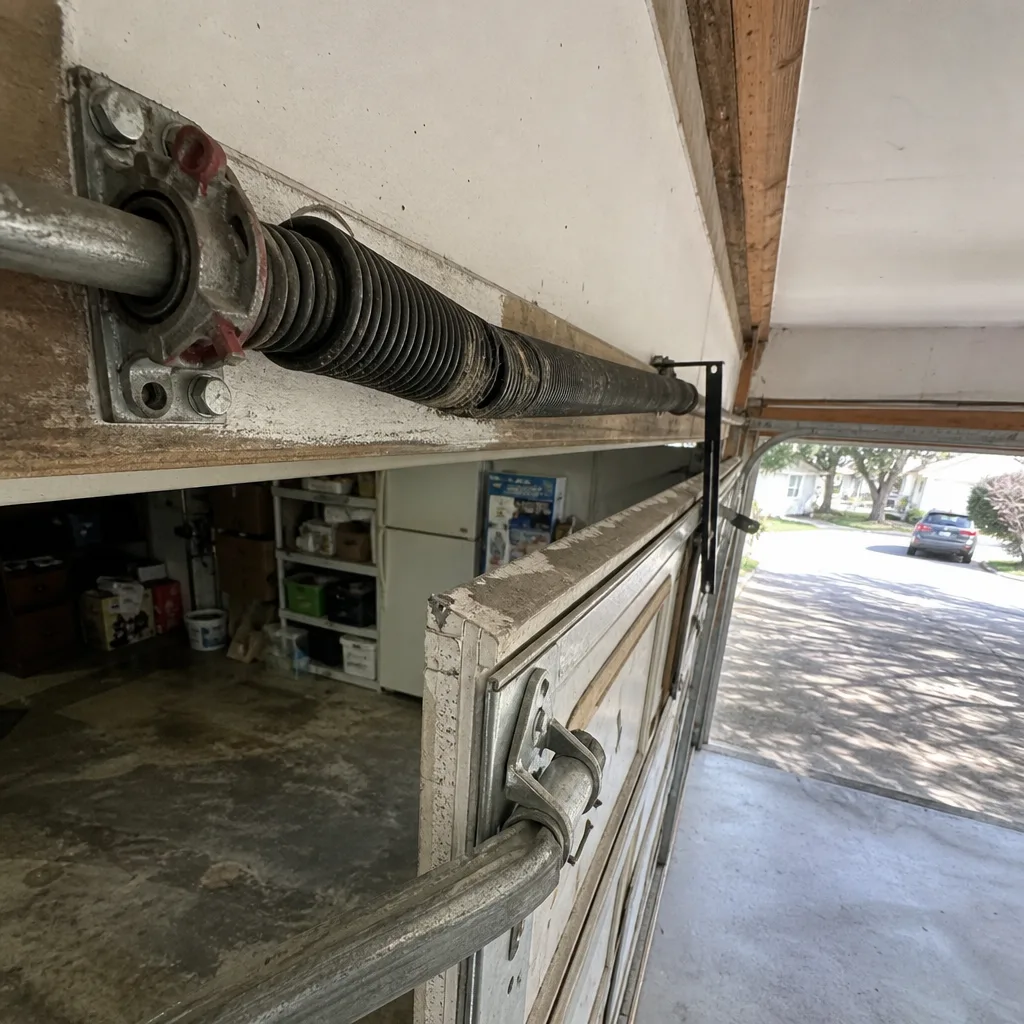 Before
 After
After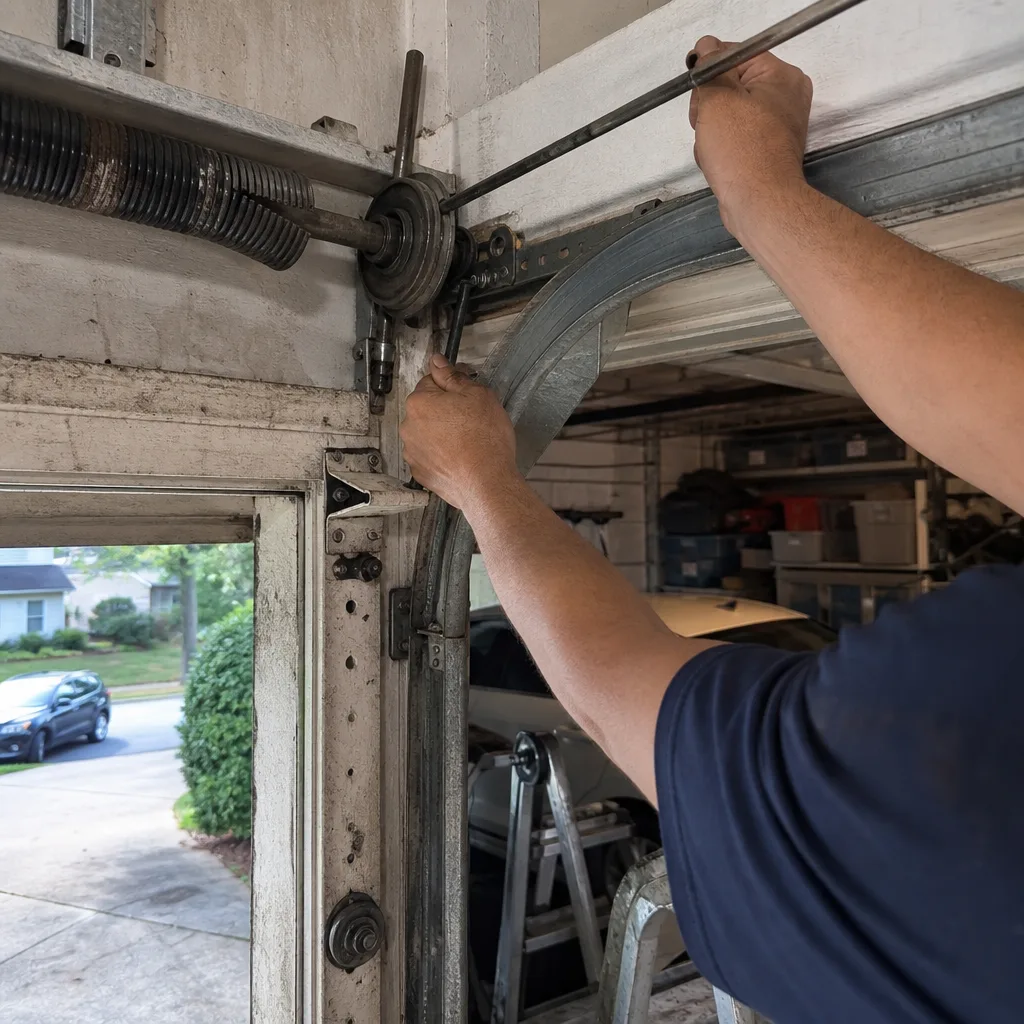 Before
 After
AfterDIY vs Professional Garage Door: The Johns Creek Homeowner’s Decision Guide
Torsion springs store enough energy to fracture a wrist or orbital bone when released incorrectly. That’s not a warning to scare you away from your garage; it’s the reason the DIY decision needs to be made task-by-task, not door-by-door. In Johns Creek, where garage doors cycle open and closed thousands of times a year through heat, humidity, and late-afternoon thunderstorms, certain repairs are genuinely safe for a competent homeowner with basic tools. Others require the kind of training and equipment a technician carries. This guide gives you the framework to tell the difference, the cost reality check behind each option, and the Garage Door Cost Breakdown: The Johns Creek Homeowner’s Reference for 2026 you should expect from any professional who works on your door.
Quick Answer
Most garage door maintenance and minor repair tasks, like weatherseal replacement, roller swaps, and sensor cleaning, are safe DIY jobs for Johns Creek homeowners with basic tools and patience. Anything involving torsion springs, lift cables, or full-door weight should be left to a professional, regardless of your mechanical skill level. The dividing line isn’t talent; it’s where the stored energy sits and what happens if your hand slips.
Table of Contents
- The Risk Profile: Why “Garage Door” Is Seven Different Jobs, Not One
- The Task-Level Decision Matrix: What You Can Do, What You Shouldn’t
- The Tool Cost Reality Check: What DIY Actually Costs in Johns Creek
- Georgia Liability: What Your Insurance Adjuster Looks For
- How to Evaluate a YouTube Repair Video Before Following It
- The Middle Path: Professional Diagnosis, Owner Decision
- Johns Creek-Specific Factors: Climate, Codes, and Housing Stock
- Common Mistakes to Avoid
- When to Call a Professional
- Frequently Asked Questions
BeforeAfterThe Risk Profile: Why “Garage Door” Is Seven Different Jobs, Not One
A garage door is not a single machine. It’s a system of components with wildly different failure modes and danger levels. The plastic gear inside your LiftMaster opener wears down smoothly and fails quietly. The torsion spring above your door fails suddenly, releasing stored energy that can move steel bars at lethal speed. The rubber weatherseal along the bottom tears gradually and costs fourteen dollars to replace.
We see the conflation happen constantly in Johns Creek. A homeowner watches a video about replacing a bottom seal, feels confident, and then decides to “take a look” at the spring while the ladder is out. That’s the exact moment the risk profile changes from handyman project to licensed trade. The skill required to do either task is not the issue. The stored energy is.
Here’s the framework we use with every homeowner who calls us asking whether they can handle something themselves:
- No stored energy, no full door weight: Safe DIY territory. Weatherseal, hinges, brackets, sensors, keypad programming, opener logic board swap on models like the Chamberlain or Craftsman.
- Full door weight involved: Caution zone. Roller replacement on certain doors, some cable evaluations. Door weight ranges from 130 to 400+ pounds depending on the material and size.
- Stored mechanical energy involved: Professional territory, no exceptions. Torsion springs, extension springs under tension, cables under load, anything connected to the spring system.
In our experience across Johns Creek neighborhoods from Medlock Bridge to Bellmoore Park, the homeowners who handle DIY well are the ones who can identify which category their task falls into before touching anything. The ones who get hurt are the ones who treat the entire door as one low-risk unit.
The Task-Level Decision Matrix: What You Can Do, What You Shouldn’t
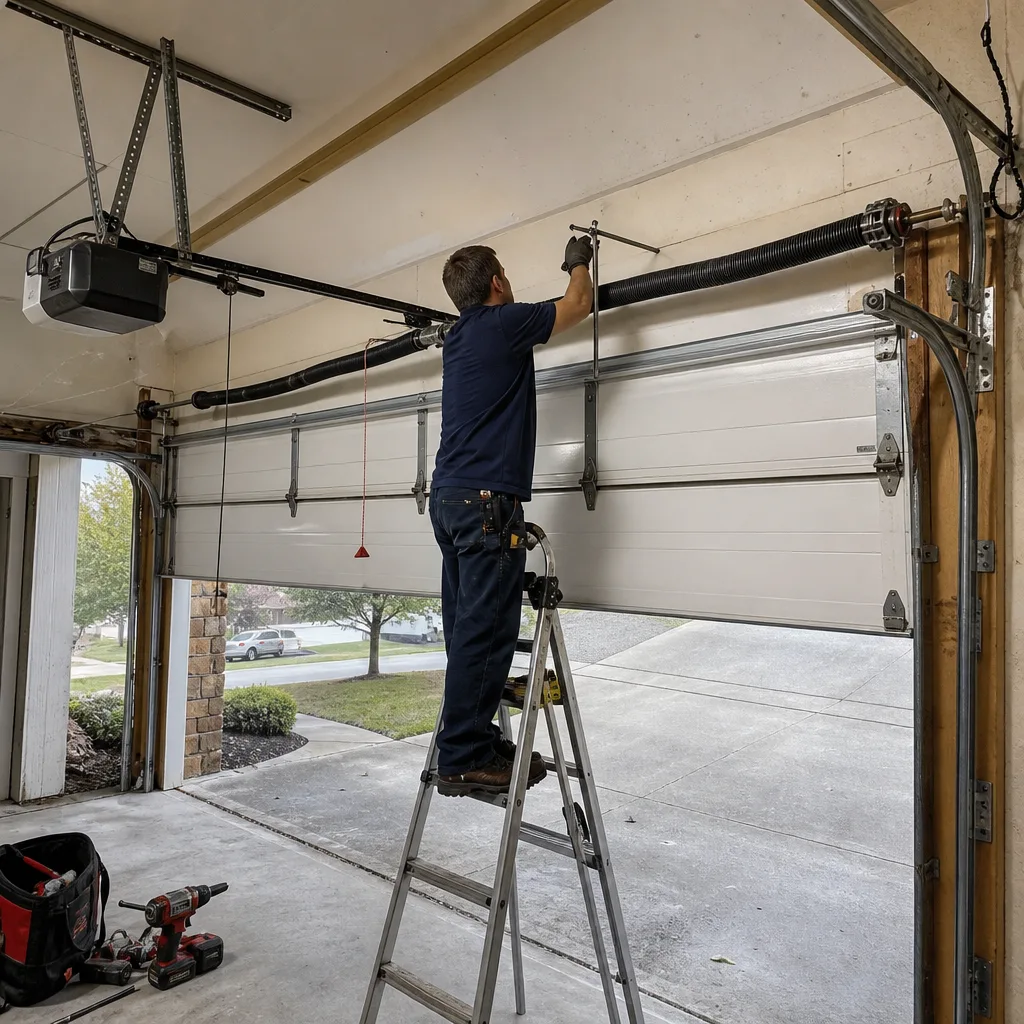
The DIY-versus-professional decision lives at the task level. Here’s the breakdown of what a mechanically competent homeowner can handle safely versus what requires a technician regardless of skill, with the reasoning behind each. For more guides & resources on keeping your door in top shape, see our full checklist.
Safe DIY Tasks (With Basic Tools and Patience)
Weatherseal replacement. The rubber strip along the bottom of your door cracks and tears after three to five Georgia summers. The replacement costs about $14 to $30 depending on door width, and installation requires nothing more than pliers, a flathead screwdriver, and maybe a utility knife. No springs, no tension, no door disassembly. If you can change a windshield wiper blade, you can do this.
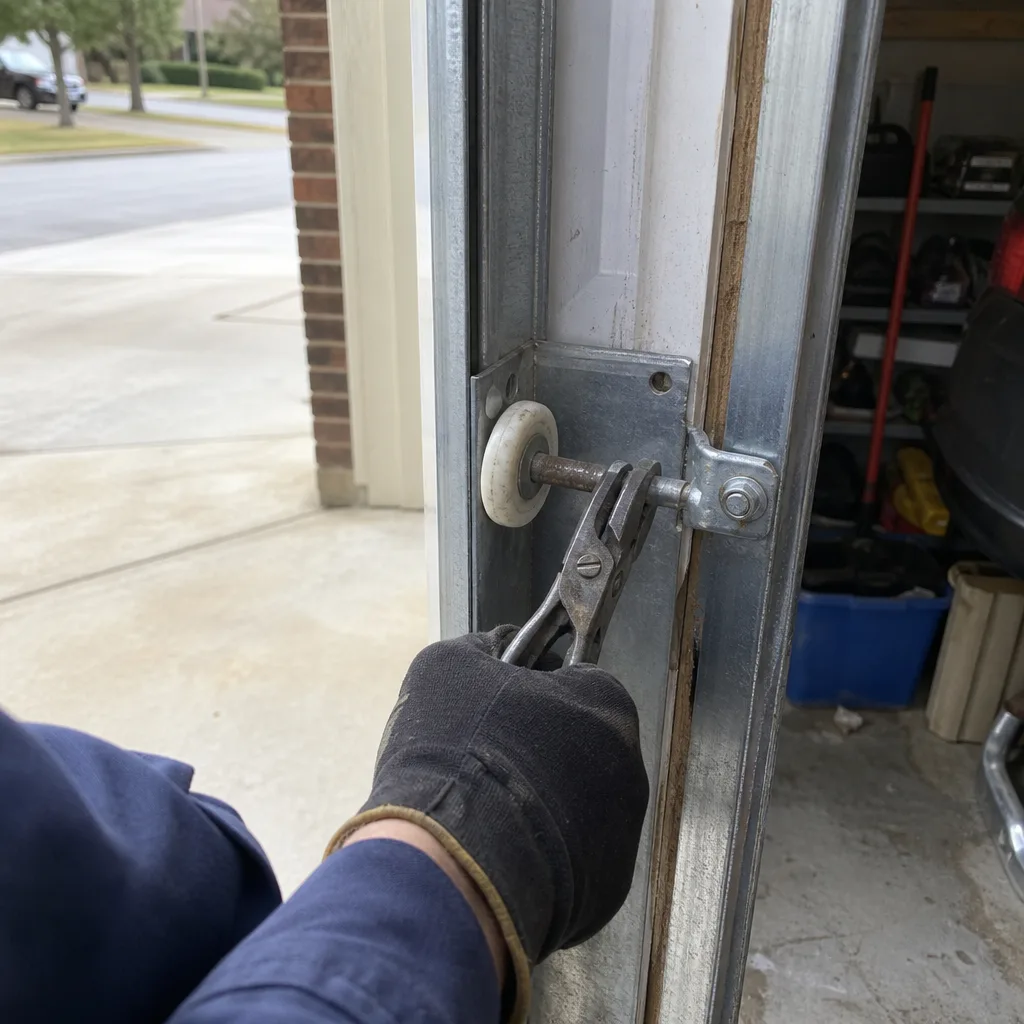
Roller swap on extension spring doors only. If your ceiling has two springs stretched horizontally along the tracks, those are extension springs. On many of these systems, you can replace a worn roller with a socket set and a pry bar, because the door stays supported by the track and the spring tension is not released during the swap. The caveat: some extension spring setups still require the cable to be disconnected, which changes the risk. Check the setup before starting.
Logic board swap on an opener. When a LiftMaster or Chamberlain opener stops responding and you’ve ruled out the wall button, safety sensors, and power source, the logic board is often the culprit. It’s a circuit board held in by a few screws and ribbon connectors. A replacement board typically costs $80 to $150, and the swap is plug-and-play. The critical step is disconnecting the opener from power at the outlet first, not just the wall button.
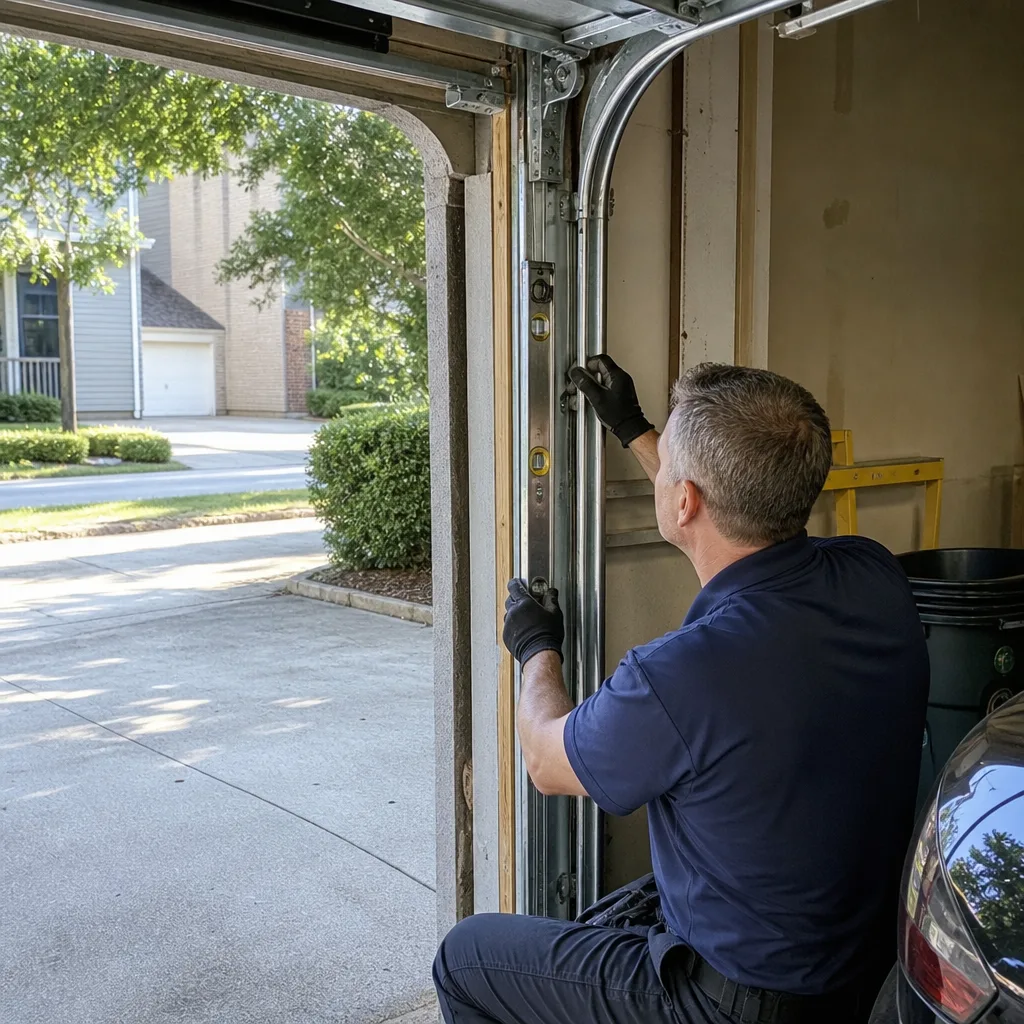
Safety sensor alignment and cleaning. The photo-eye sensors at the bottom of each track get bumped, dusty, or misaligned. A clean cloth, a level, and ten minutes usually fix the blinking-light problem. This is a genuinely good DIY task for Johns Creek homeowners because sensors drift out of alignment seasonally as the concrete pad shifts with temperature changes.
Professional-Only Tasks (Regardless of Skill Level)
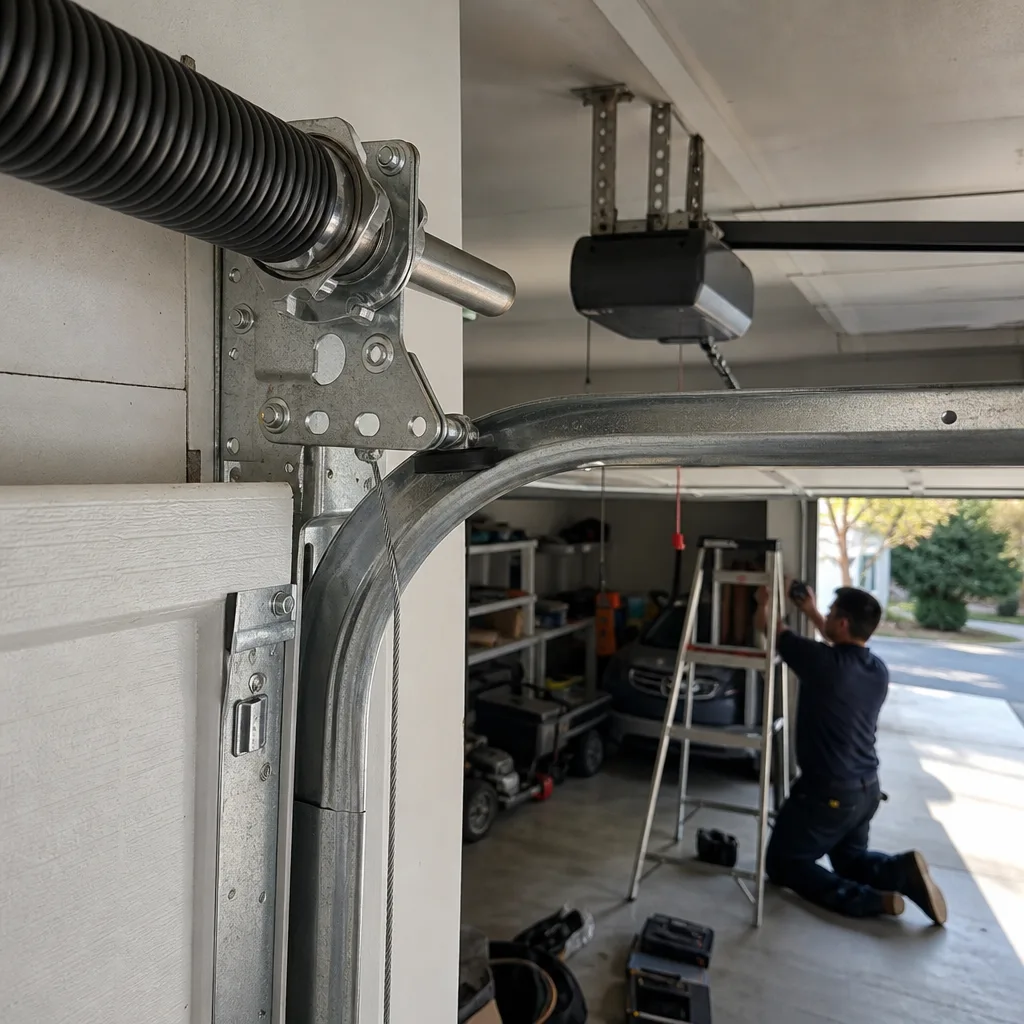
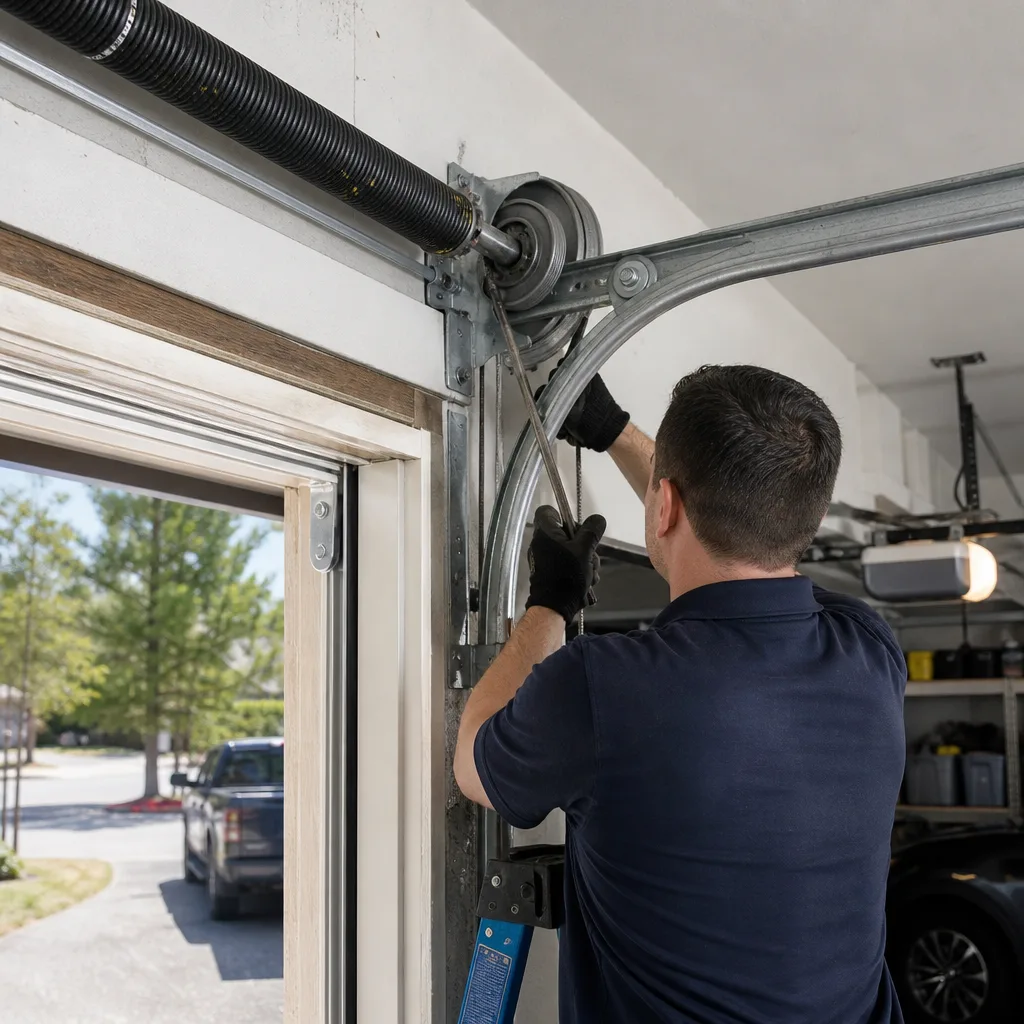
Torsion spring replacement or winding. The spring mounted on a steel tube above the closed door holds enough energy to move a 400-pound door. Winding it requires two steel winding bars, a specific number of quarter-turns based on the door’s exact height and weight, and a mathematical calculation before the first bar touches the spring. A wrong turn count doesn’t just mean the door won’t work; it means the spring can snap and send the winding bar sideways at bone-breaking velocity. We don’t care how mechanically gifted you are. This is not a DIY job.
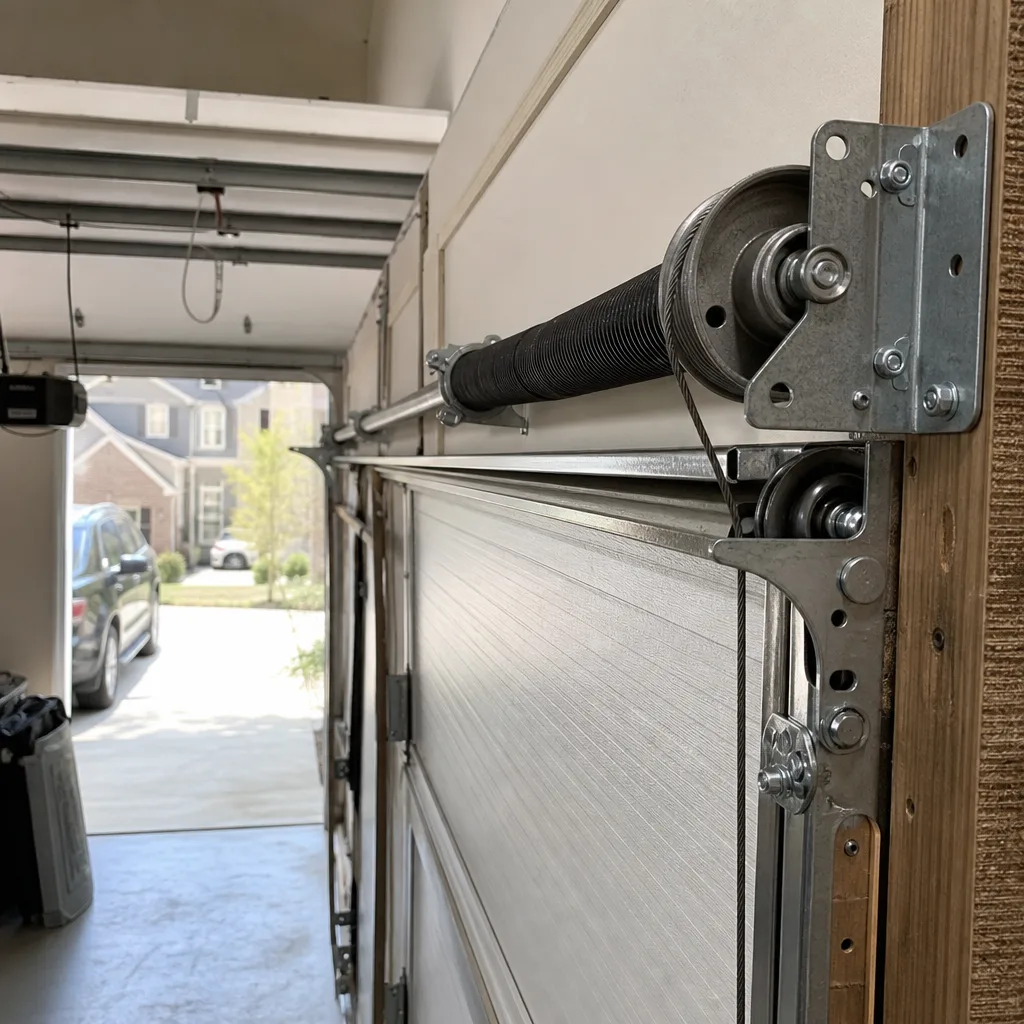
Cable re-drumming or replacement. The lift cables run from the bottom brackets through the drums at each end of the spring tube. Replacing a cable means supporting the full door weight, releasing tension system-wide, re-running the cable, and re-tensioning everything in sequence. One missed step can drop the door or create a cable slack that whips when the door moves. A Raynor or Wayne Dalton door with a broken cable is a call-a-technician moment.
Track realignment on doors over 200 pounds. Wood, glass, and some insulated steel doors exceed 200 pounds. Bent or misaligned tracks hold that weight in place, and “tapping” a track back into alignment while the door hangs under tension is how fingers get severed and doors fall on people. If the door is heavy enough that you can’t lift it from the closed position without visible effort, the track work belongs to someone with a door jack and the right bar clamps.
The Tool Cost Reality Check: What DIY Actually Costs in Johns Creek
Here’s the calculation most online forums skip: the tool cost. Everyone quotes part prices. Nobody adds up what it costs to buy the equipment you’ll use once.
Take torsion spring replacement. The springs themselves run $60 to $120 for the pair, depending on wire diameter and length. But you cannot safely wind a torsion spring with a screwdriver or a pry bar. You need:
- Winding bars: Two steel bars sized to your specific spring’s winding cone. $25 to $45 for a set.
- A spring calculator: Available online, but you need to know your door’s exact height, weight, track radius, and spring wire diameter to get a correct turn count. Guessing is not a calculation.
- A torque reference: Not a torque wrench, exactly, but a calibrated understanding of how many quarter-turns you’ve applied and whether the door balances correctly afterward. One wrong quarter-turn changes the door’s balance and strains the opener.
So the tool cost for a one-time torsion spring replacement lands around $60 to $80, assuming you buy the winding bars and don’t already own them. The labor saving on a professional spring replacement in Johns Creek typically runs $150 to $200. You’d be saving roughly $70 to $140 on a task where a mistake can fracture your orbital bone. That’s the math. We think it speaks for itself.
Compare that to weatherseal replacement. The tool cost is essentially zero. The part is $14 to $30. The professional charge for the same job is $90 to $130, and most of that is the house call, not the labor. That’s a rational DIY savings of $60 to $100 on a task with no stored energy. The decision matrix handles it: zero risk, real savings, do it yourself.
Georgia Liability: What Your Insurance Adjuster Looks For
Here’s a conversation that happens more often than anyone wants to admit. A Johns Creek homeowner installs a garage door component themselves. Six months later, the component fails. The door drops, the car gets damaged, or a family member gets hurt. The homeowner files an insurance claim. The adjuster asks one question: who installed this?
When the answer is “the homeowner,” the claim enters a gray area that professional installation simply doesn’t have. Most Georgia homeowners insurance policies cover sudden and accidental damage, but they cover the damage, not the defective workmanship that caused it. If a self-installed torsion spring fails because it was wound to the wrong turn count, the adjuster may characterize the resulting damage as a maintenance issue rather than a covered peril. That’s the “installed by owner” documentation gap.
Professional installation closes that gap with a paper trail. A written invoice, a work order describing the parts and the torque applied, and a photo record of the completed installation all serve as evidence that the work was done to a documented standard. When the adjuster asks who installed the spring, you hand them the paperwork and the conversation moves on. When the answer is “I did it myself,” you’re effectively asking your insurance company to trust your amateur workmanship. They often won’t.
This isn’t a reason to avoid all DIY. It’s a reason to be selective. Weatherseal replacement that goes wrong costs you a $20 strip. Torsion spring work that goes wrong costs you a potential claim denial. The liability profile tracks the risk profile, which tracks the stored-energy profile. Same system.
How to Evaluate a YouTube Repair Video Before Following It
We’ll say the quiet part out loud: most garage door repair videos on YouTube are filmed by people who got lucky. The video shows the repair working, so the technique looks valid. What the video rarely shows is the person’s second attempt after the first one failed, or the spring they unwound because they miscounted, or the trip to the urgent care that got edited out.
So when you’re evaluating a tutorial for any garage door task, look for three things a credible video will always show:
- The specific spring type being addressed. A credible video names the spring: torsion or extension, wire diameter or color code, single or double spring setup. If the video says “your spring” without identifying what kind it is, the creator doesn’t know enough to teach you. Different springs fail differently, and the technique for one does not transfer to the other.
- A torque or turn count being stated. On a torsion spring, the video should state the exact number of quarter-turns required and explain where that number came from, typically the door height and a spring calculator. If the host says “just wind it until it feels right,” close the video. “Feels right” is how springs get overwound.
- The door weight being confirmed. A credible video addresses the door’s weight because it determines everything else: spring size, cable tension, track hardware, and opener force limits. If the video never mentions door weight, the person filming doesn’t understand the system they’re working on.
Videos that skip straight to the winding step, that don’t show the door being weighed or measured, or that don’t identify the specific spring they’re touching, are entertainment, not instruction. Watch them for context if you want, but do not follow them as a guide.
The Middle Path: Professional Diagnosis, Owner Decision
There’s an option most Johns Creek homeowners don’t know exists. It’s not binary. You don’t have to choose between “do everything yourself” and “hand the whole job to a contractor.”
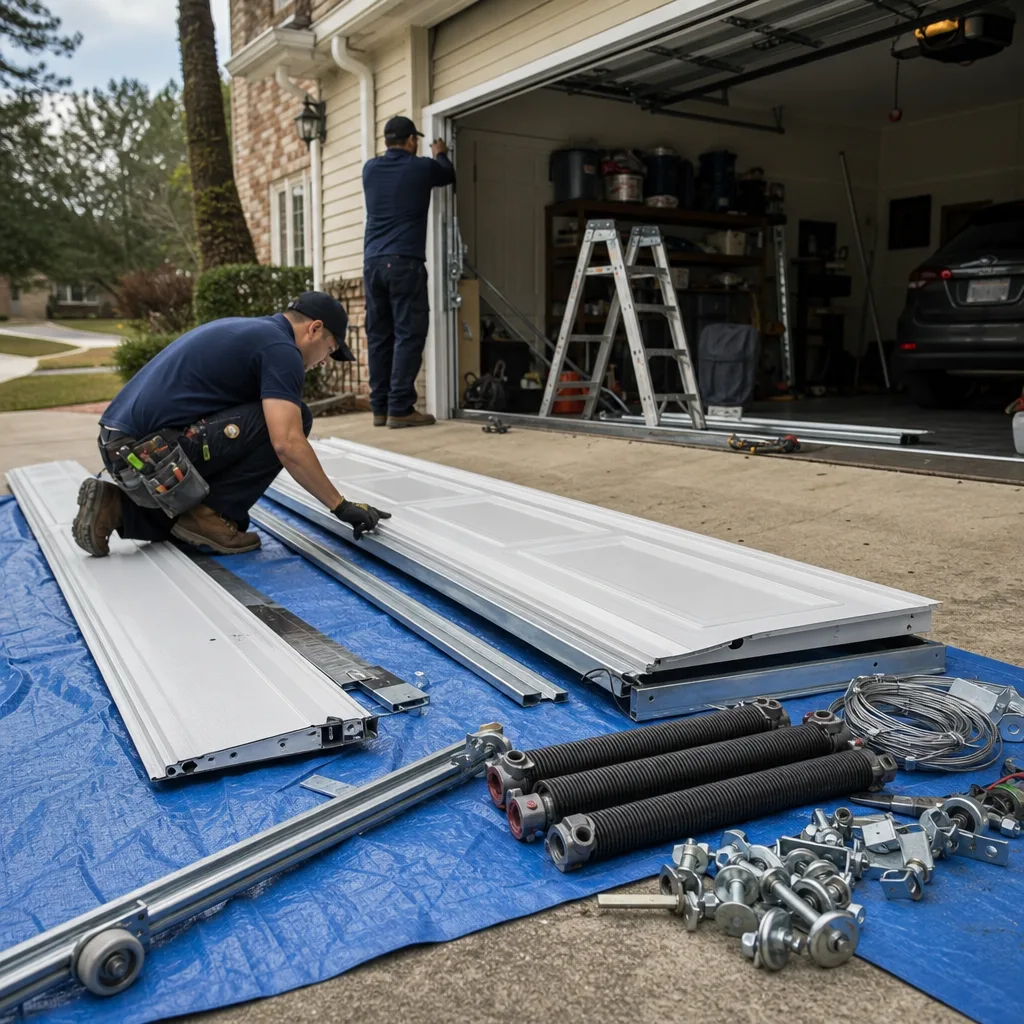
Here’s how it works. You call a garage door company and pay for a diagnosis. The technician arrives, inspects the door, identifies the failed part, and documents the finding for you. A good technician will give you the part name, the part number, the itemized cost of the part, and the labor estimate in writing, and that written estimate is yours regardless of whether you proceed. You now have the answer to what’s actually wrong, and the answer to what it costs to fix professionally, in your hands.
From there, you make an informed decision. If the failed part is a weatherseal, you now know the exact profile and width to buy at the hardware store. If it’s a torsion spring, you now know the wire diameter and the spring size, and you also know what the professional charge would be, which makes your DIY-versus-professional calculation real instead of hypothetical.
At Servo Garage Doors Johns Creek, we photograph the failed component before quoting a replacement. That’s not a marketing gimmick. It’s a founding rule, and it’s codified as Clause 4 of The Haven Standard. The customer sees the failed part before anyone quotes a replacement. When you have that photo record and the written price in front of you, your decision about whether to proceed with us or attempt the repair yourself becomes an evidence-based choice, not a leap of faith. And on complex diagnosis work, the documentation alone is often worth the service call.
Johns Creek-Specific Factors: Climate, Codes, and Housing Stock
Johns Creek’s garage doors age a little differently than garage doors in, say, Phoenix or Minneapolis, and that affects which components fail and when. Three factors matter here.
Humidity and heat cycling. Johns Creek summers push garage temperatures well past 100 degrees, and the humidity accelerates two things. Weatherseals dry, crack, and tear faster than in drier climates. And the torsion springs, which have a finite cycle life of roughly 10,000 cycles regardless of temperature, tend to fatigue faster in the heat because the metal expands and contracts daily. A spring that would last 10 years in Colorado might fail in 7 years in Johns Creek. If your door is original to a home built between 2015 and 2025, you’re likely approaching your first spring replacement window.
Housing stock. Johns Creek has a mix of newer construction in neighborhoods like Bellmoore Park and older, larger homes in communities like Doublegate and Country Club of the South. The older homes often have heavier wood or solid-core doors, sometimes 300 to 400 pounds with custom sizing. Those doors demand more from their springs and cables, and they’re more dangerous to work on. The newer homes tend to have standard-size insulated steel doors, which are lighter and more predictable. Knowing your door’s material and weight is the first step in any DIY evaluation.
Permit and code considerations. Garage door replacement in Johns Creek does not typically require a building permit for a same-size residential swap, but if you’re changing the opening, moving tracks, or installing a new header, you may be triggering permit territory. The city follows Georgia state building codes for wind load requirements, and garage doors in a windborne debris region need to meet Miami-Dade or equivalent standards if you’re replacing the door entirely. A homeowner self-installing a door that doesn’t meet wind load code creates a compliance issue that surfaces at resale. Professional garage door installation in Johns Creek includes that compliance check as part of the written scope.
Common Mistakes to Avoid
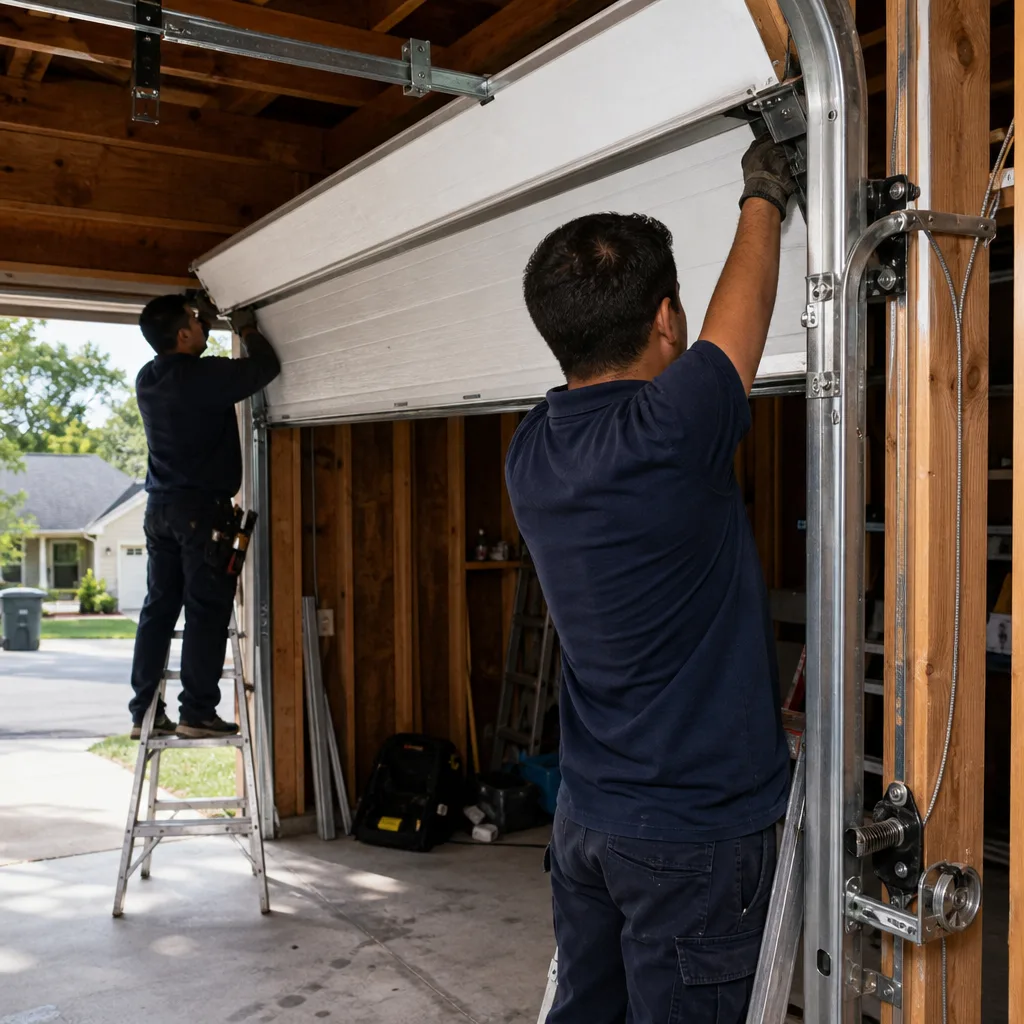
- Treating every garage door task as the same risk level. Replacing a weatherseal and winding a torsion spring share one thing in common: they happen near a garage door. That’s where the similarity ends. Evaluate each task’s stored-energy profile before picking up anything.
- Using a screwdriver as a winding bar. Torsion springs cannot be safely wound with improvised tools. The correct winding bar is a specific steel rod sized to the winding cone. A screwdriver can slip out, and when a spring under load releases, the tool moves faster than your hand can react.
- Skipping the spring calculator. Turn counts are not guesses. The number of quarter-turns depends on your door’s height and the spring’s wire diameter. An overwound spring isn’t “extra safe”; it’s a premature failure waiting to happen.
- Trusting a video that shows the technique working once. One successful attempt does not make the technique safe. Without a stated turn count, door weight, and spring identification, the video is a lottery ticket, not an instruction manual.
- Ignoring the documentation gap on insurance. A self-installed component that fails and causes damage puts you in the position of explaining your own workmanship to an adjuster. Professional work comes with a paper trail. In Johns Creek, where a single garage door damage claim can run several thousand dollars, the paper trail matters.
- Replacing one spring only. Garage door springs are installed in pairs for a reason. If one has failed, the other is likely close to the end of its cycle life, and replacing only the failed one creates a balance problem that strains the opener and shortens the new spring’s life.
When to Call a Professional
Call a professional when the task involves stored mechanical energy, full door weight, or an insurance-adjacent risk. Torsion springs, extension springs under tension, lift cables, and track realignment on heavy doors all fall into that category. Call when your door won’t open and your car is trapped inside, because a door under failure tension is not the place to start experimenting. Call when you’ve already attempted a repair and something feels off, because second-attempt fixes are always more expensive than first-attempt professional work. And call when you want a diagnosis in writing, with a photo record and a flat price, before you decide what to do. Servo Garage Doors Johns Creek offers free estimates in Johns Creek; call (470) 380-0642 and we’ll put the diagnosis and the written scope in your hands before any work starts.
Frequently Asked Questions
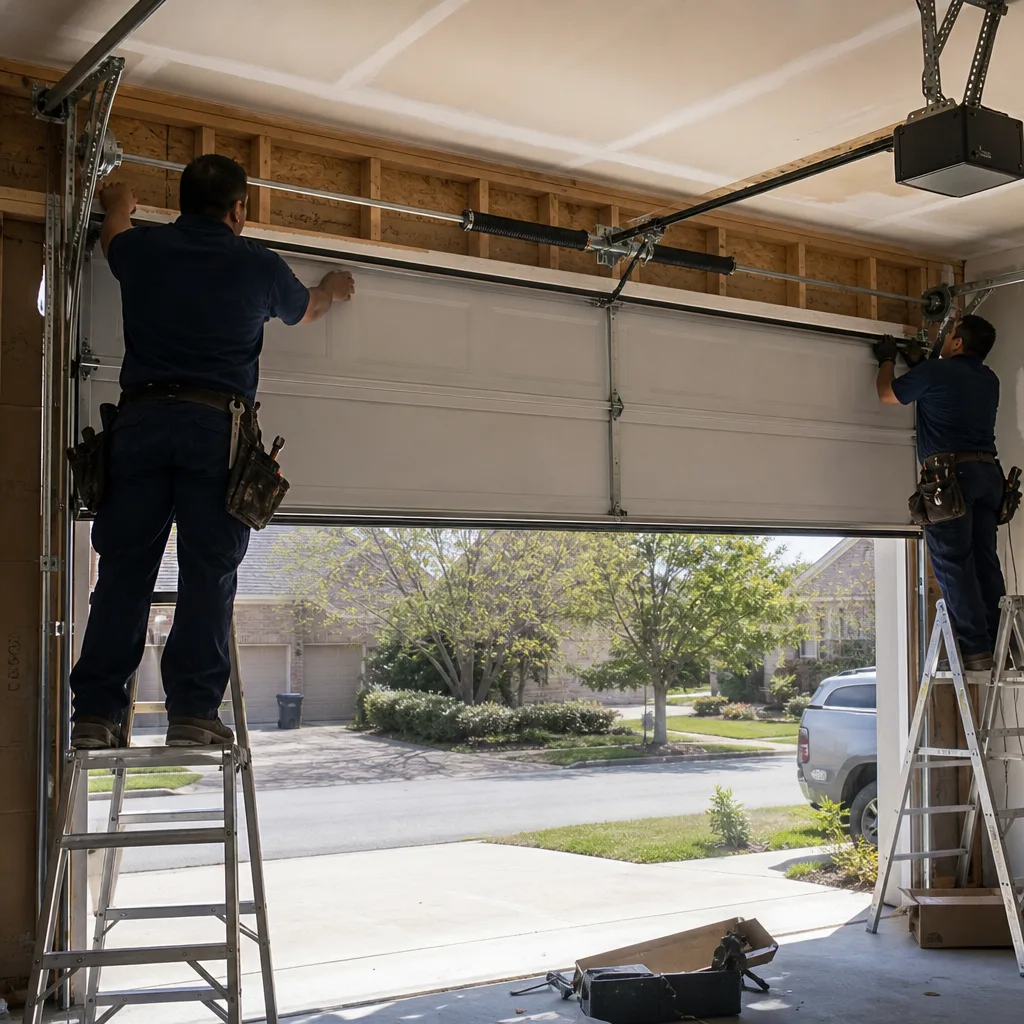
No, and we don’t recommend it regardless of your mechanical skill. Torsion springs store enough energy to cause serious injury if released incorrectly, and extension springs under tension carry similar risk. The tool cost for winding bars runs $25 to $45, and the labor saving over professional repair is typically $150 to $200. The math doesn’t justify the risk. If you’re in Johns Creek and need spring work, call us at (470) 380-0642 for a written price before any work begins.
Most garage door repairs in Johns Creek run between $120 and $350 for common issues like weatherseal replacement, roller swaps, sensor realignment, and general tune-ups. Torsion spring replacement typically lands between $250 and $400 depending on spring size and door weight. Opener logic board swaps run $180 to $300 parts and labor combined. We quote every job with a flat, written price and written scope before any work starts, so the number you approve is the number you pay.
DIY weatherseal replacement costs $14 to $30 for the seal itself, with zero tool cost if you own pliers and a screwdriver. Professional weatherseal replacement in Johns Creek typically runs $90 to $130, with most of that being the house call. It’s one of the few garage door tasks where DIY makes clear financial sense.
The answer depends on what failed and how the damage happened. Most Georgia homeowners policies cover sudden and accidental damage, but they do not cover damage caused by defective workmanship. If a self-installed spring fails because it was wound incorrectly, the adjuster may deny the claim on the basis that the installation itself was the problem. Professional work comes with documentation that supports your claim. It’s a difference worth considering before you touch anything under tension.
Yes. Servo Garage Doors Johns Creek is independently owned and operated under The Haven Standard, led by Marcus Deller, serving Johns Creek since 2015. We hold our own license and insurance, service all major brands including Wayne Dalton, Craftsman, Raynor, and LiftMaster, and we deliver a documented photo record on every visit.
Yes. Bring us any written estimate from another company, and we’ll give you a free second opinion. It’s part of the way we work: Servo Garage Doors Johns Creek puts prices in writing before any work starts, and we’re comfortable standing next to a competitor’s number. No coupon, no code, just bring the paperwork.
Based on the calls we answer across Johns Creek, broken torsion springs lead the list, followed by worn rollers and misaligned safety sensors. The heat and humidity accelerate spring fatigue, and the daily open-close cycle on a two-car household adds roughly 1,500 cycles per year. If your door is original to a home built around 2015, you’re likely near or past the typical spring replacement window.
For most garage door opener repairs, we can diagnose and fix the issue in a single visit to your Johns Creek home. Common problems like failed logic boards, stripped gears, and sensor misalignment are typically repaired same-day because we carry parts for LiftMaster, Chamberlain, Genie, Craftsman, and Raynor on the truck. Call (470) 380-0642 and we’ll give you a straight answer on timing.
The Bottom Line
The DIY-versus-professional decision for your Johns Creek garage door comes down to one question: does the task involve stored energy? If the answer is no, and you own basic tools, several maintenance tasks are rational DIY projects with real savings. If the answer is yes, the decision is already made for you. The tool cost doesn’t justify the risk, the insurance exposure compounds the problem, and the worst-case outcome isn’t a broken door; it’s a broken bone or a denied claim. At Servo Garage Doors Johns Creek, our position is simple: we photograph the failed part before quoting the repair, we put every price in writing before any work starts, and if you’d rather handle the safe tasks yourself, we’ll tell you honestly which ones those are. Call us at (470) 380-0642 for a free estimate, and you’ll have the documentation to decide.
Written by Marcus Deller, Owner at Servo Garage Doors Johns Creek, serving Johns Creek since 2015.