
Last updated September 20, 2026
Full 25-point door and opener safety check with every visit - springs, cables, rollers, tracks, and your LiftMaster or Chamberlain opener included
You get a price before we start. It does not change when the truck arrives.
 Before
 After
After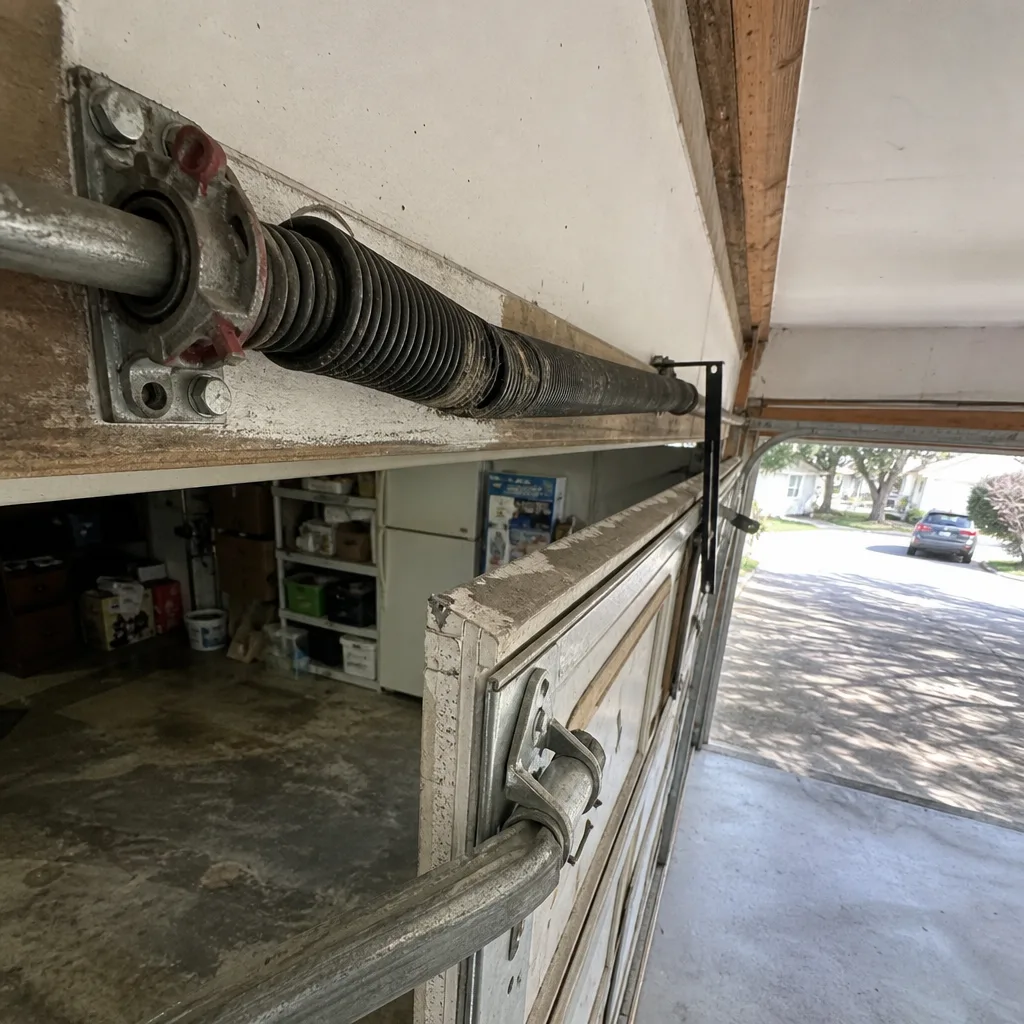 Before
 After
After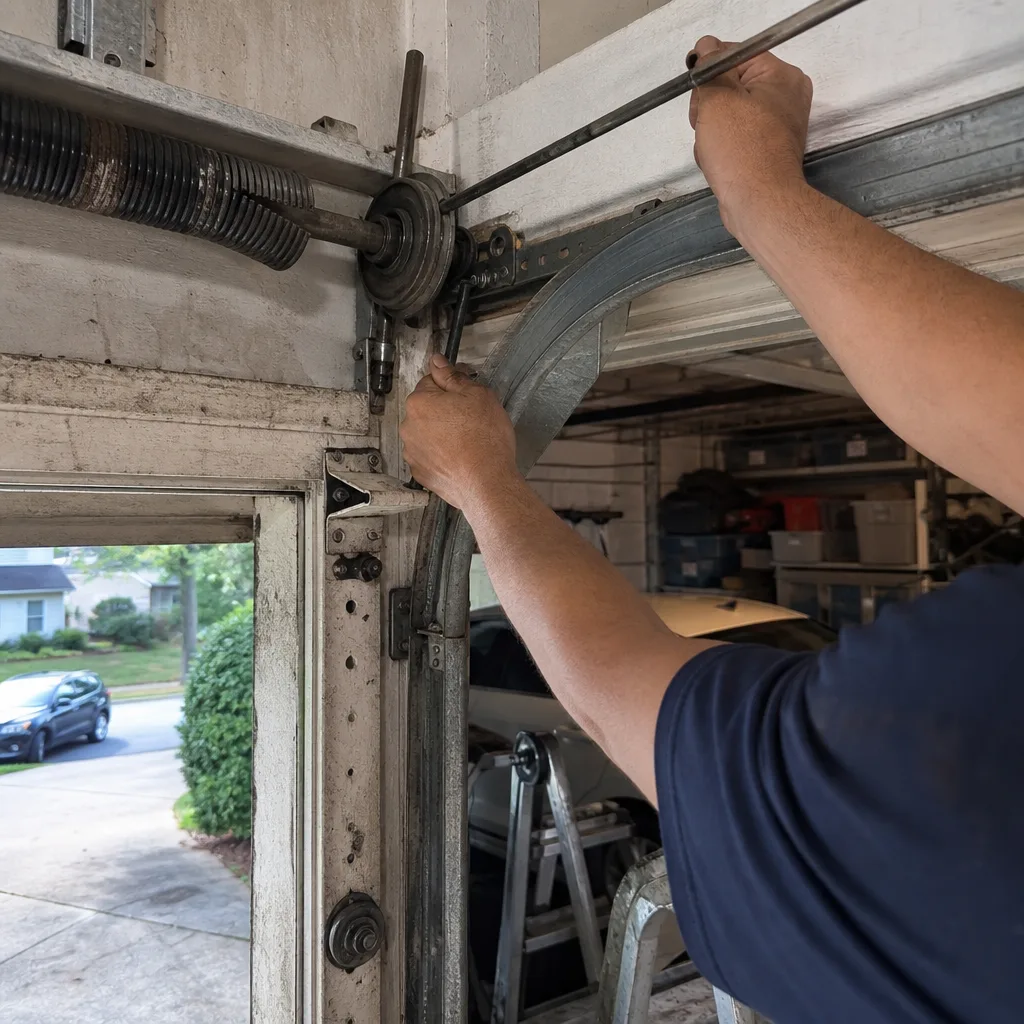 Before
 After
AfterGarage Door Warning Signs: A Johns Creek Homeowner’s Reference Guide
A garage door doesn’t fail without warning. It warns you with a sound, a speed change, or a visible gap. Most Johns Creek homeowners notice these signals weeks or months before a breakdown, but without a reference point, they can’t tell a $0 lubrication task from a spring that’s hours away from snapping. This guide-along with our Complete Guide to Garage Door in Johns Creek-names each warning sign, explains what it means in mechanical terms, and puts a dollar range on the repair so the decision to call is based on evidence, not anxiety.
Quick Answer
The most important garage door warning signs in Johns Creek are a grinding sound from worn rollers, a door that rises unevenly or drops when lifted by hand, visible rust pitting on torsion springs, frayed cables near the drum, and a two-inch gap between the spring coils. A squeak is usually harmless. A grind is not. Uneven travel points to spring tension imbalance, not an opener problem. And rust that pits the spring means fatigue life is nearly gone.
Table of Contents
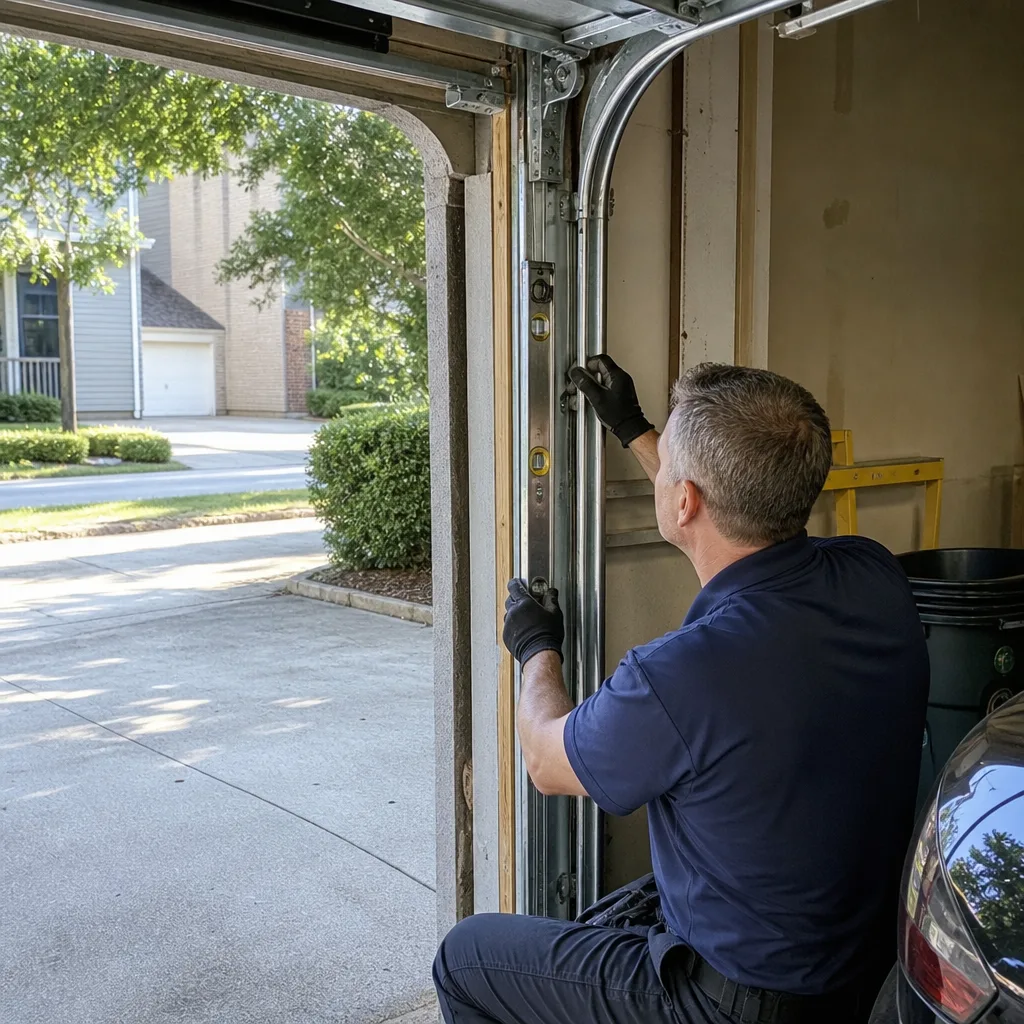
- Sound Signals: Squeak vs. Grind vs. Pop
- Uneven Door Travel: What It Actually Means
- The Two-Inch Manual Lift Test
- Reading Rust on a Torsion Spring
- Frayed Cables: The Time-Sensitive Warning
- Opener Warning Signs That Allow a Scheduled Appointment
- Weatherseal and Track Wear: Johns Creek Climate Factors
- Common Mistakes to Avoid
- When to Call a Professional
- Frequently Asked Questions
- The Bottom Line
BeforeAfterSound Signals: Squeak vs. Grind vs. Pop
A garage door makes three distinct sounds, and each one points to a different problem with a different price tag.
The squeak is a high-pitched, rhythmic sound that happens as the door passes a specific point in its travel. You’ll hear it at the same spot every time. In our experience across Johns Creek, a squeak is almost always a roller with dry bearings or a hinge pin that needs lubrication. The fix is a $10 can of garage door lubricant and fifteen minutes of work. This is a maintenance task, not a repair. It does not get worse quickly, and it does not damage the door if you wait a week or two.
The grind is different. A grind is lower-pitched, rougher, and sounds like metal dragging on metal, because that’s exactly what it is. When a nylon roller wears through its outer shell and the steel ball bearing inside starts rolling directly against the steel track, the sound changes from a squeak to a grind. This is a failed roller, not a dry one, and no amount of lubricant will fix it. Roller replacement in Johns Creek typically runs $120 to $180 for a full set, and it’s a same-day job. The reason the distinction matters: a homeowner who thinks they have a squeak and lubricates a grinding roller has not solved the problem. The metal-on-metal wear continues, the track gets scored, and the repair bill grows.
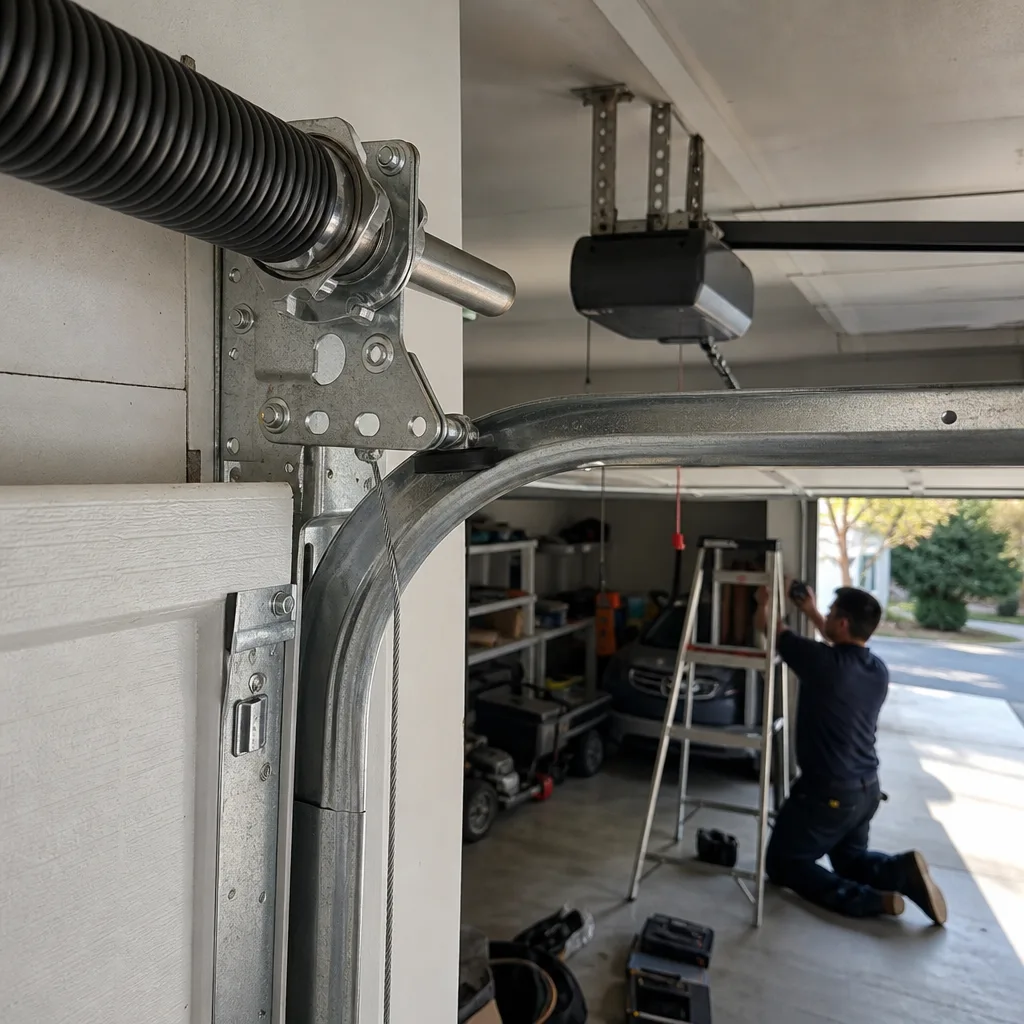
The pop is the sound nobody wants to hear. A loud, single pop from above the door, usually followed by the door slamming down or refusing to move, is a torsion spring snapping. Torsion springs are the high-tension coils mounted on a bar above the door opening. They counterbalance the door’s weight, which on a double-car garage door in Johns Creek is typically 150 to 200 pounds. When a spring breaks, the door becomes dead weight. This is a dangerous condition, and a failed spring should never be operated by hand or with the opener. Spring replacement in Johns Creek ranges from $280 to $450 for a pair, depending on door weight and cycle-rating of the replacement springs.
One note specific to Johns Creek-covered in depth in our Seasonal Garage Door Care for Johns Creek: Year-Round Homeowner’s Guide-is that homes in neighborhoods like Cambridge, Medlock Bridge, and Abbotts Bridge were built in waves during the 1990s and 2000s. We see original springs from that era failing regularly now, because standard springs were rated for roughly 10,000 cycles. A family that opens and closes the door four times a day, seven days a week, hits 10,000 cycles in about seven years. If your home was built before 2015 and the springs have never been replaced, you’re on borrowed time.
Uneven Door Travel: What It Actually Means
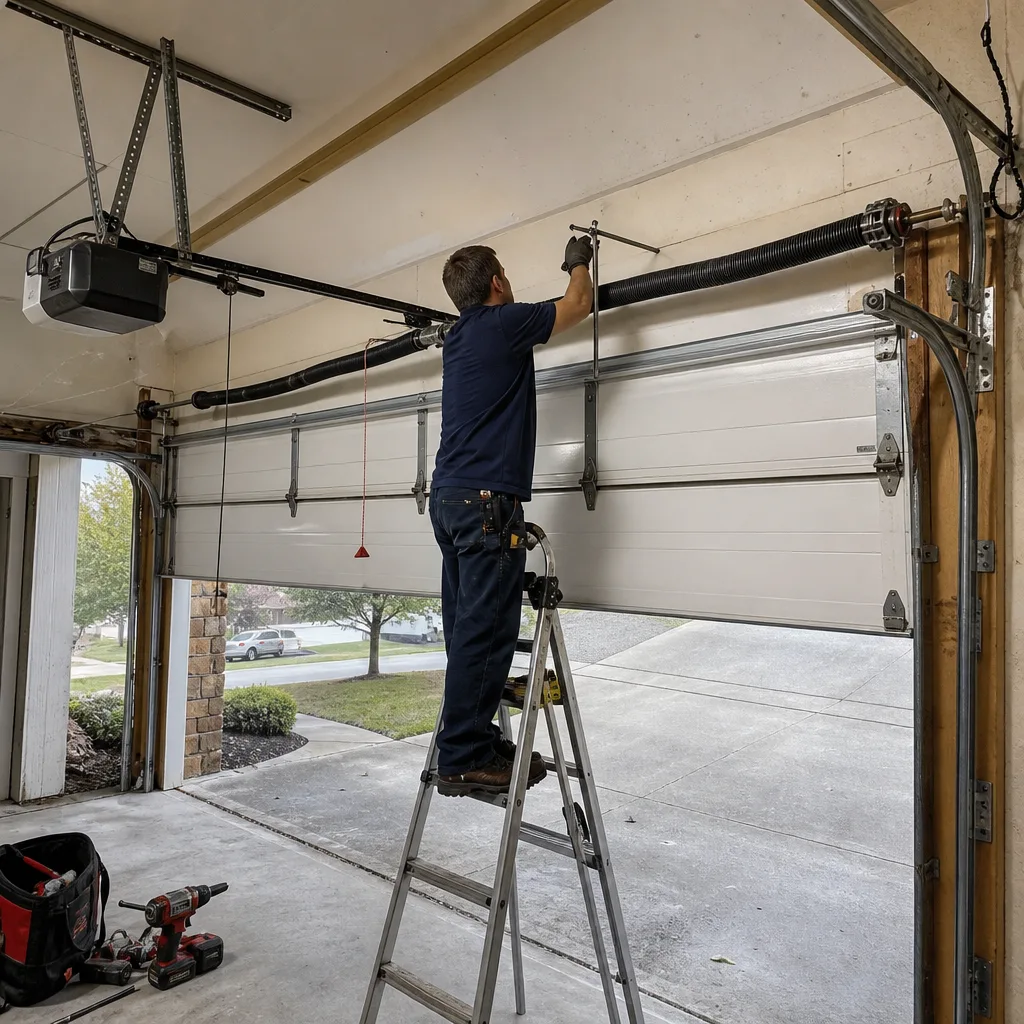
When a garage door rises faster on one side than the other, the problem is almost never the opener. This is the most misdiagnosed warning sign we see in Johns Creek, and it leads homeowners to make an expensive mistake: adjusting the opener’s force setting.
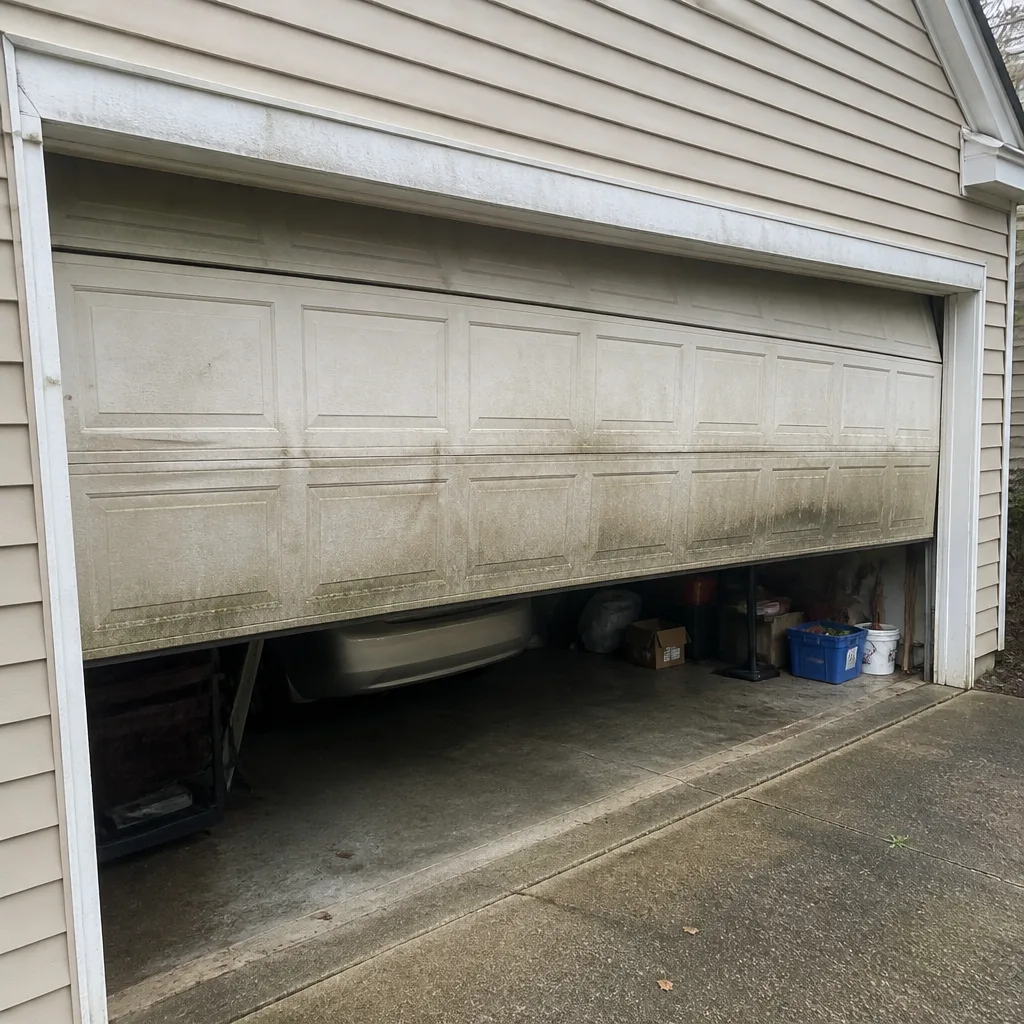
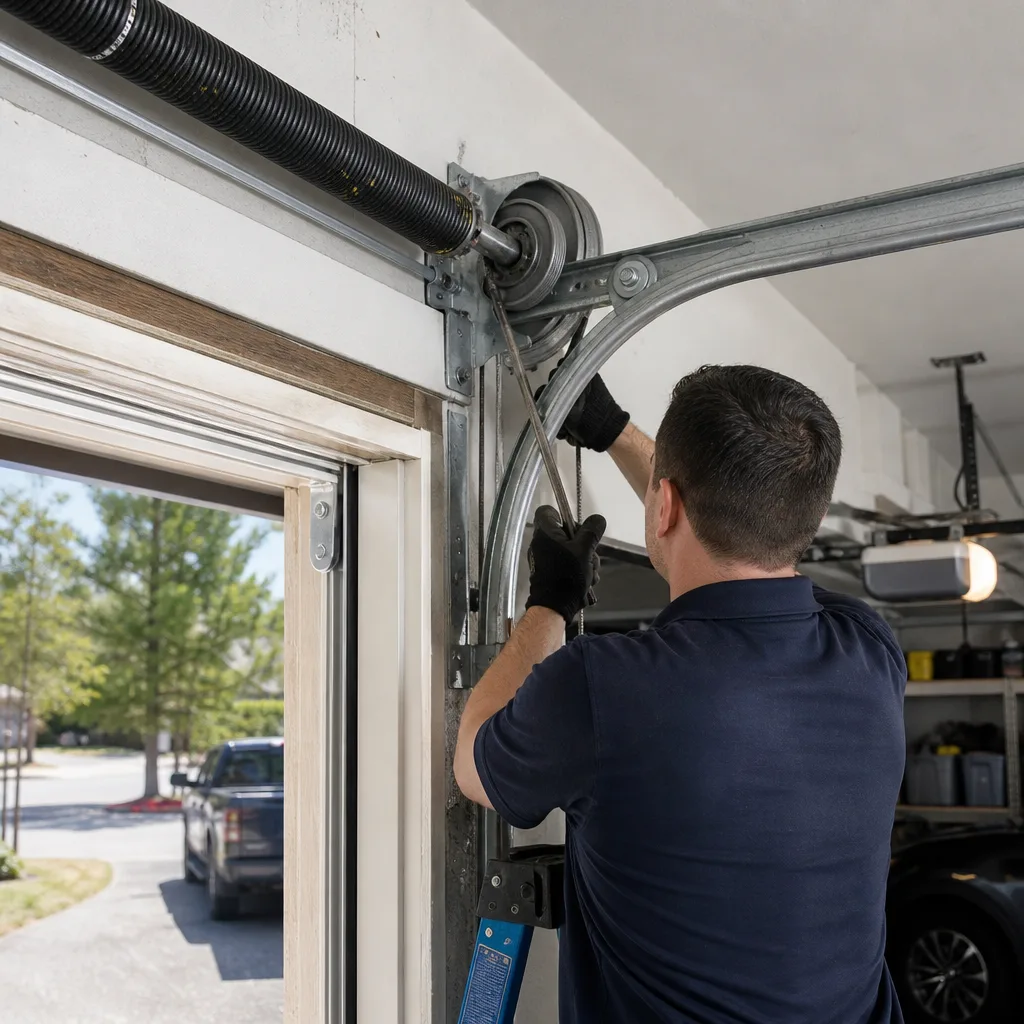
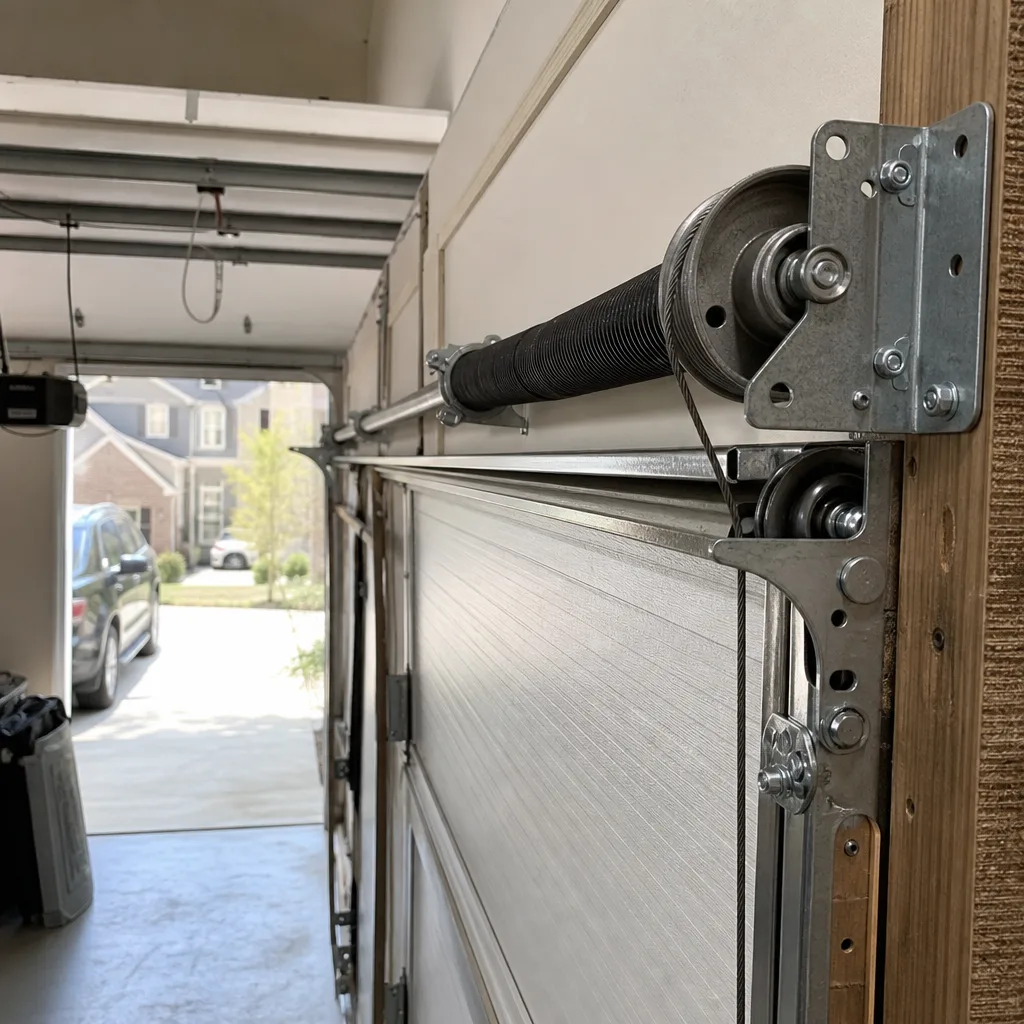
Here’s what’s actually happening. A sectional garage door is lifted by cables on both sides. Those cables are wound onto drums at each end of a bar above the door. The bar holds one or two torsion springs. The springs supply exactly the right torque to the drums so both cables lift at the same rate. When one spring loses tension, or when two springs were installed but one has failed, the torque delivered to one drum changes. One cable lifts faster than the other. The door tilts.
The opener is not the source of the imbalance. The opener is a motor that pushes or pulls the door along its travel path. It assumes the door is balanced. If the door is out of balance, the opener strains to compensate, but it cannot correct a spring tension problem. When a homeowner turns up the force setting to “fix” the uneven travel, they’re asking the opener to fight a mechanical imbalance with more force. The result is accelerated wear on the opener’s gears, on the trolley carriage, and on the door’s hinges. In a worst case, the added force can break the opener’s gear set, which is a $180 to $260 repair that would not have been necessary.
The correct fix is a spring tension adjustment or replacement. A technician measures the door’s balance state, calculates the proper spring torque for the door’s weight, and adjusts both springs so lift force is equal. This is a $120 to $180 adjustment when the springs are intact, or a $280 to $450 replacement when a spring has failed. In both cases, the price is quoted before any work starts.
The Two-Inch Manual Lift Test
There is a simple test any Johns Creek homeowner can perform that tells you more about your door’s health than anything the opener does. It’s called the manual lift test, and it takes thirty seconds.
First, pull the emergency release cord. This is the red handle hanging from the trolley carriage, the part that connects the opener rail to the door. Pulling it disconnects the door from the opener motor. Now, lift the door by hand using the bottom handle or the door’s bottom edge.
Here’s what to look for:
- Lift the door to waist height and let go. A properly balanced door stays in place. It does not drift up. It does not drift down. It holds.
- If the door drops when you let go, the springs are under-tensioned or failing. The door weighs more than the springs are counterbalancing. This is the earliest reliable sign of a spring that needs adjustment or replacement.
- If the door rises when you let go, the springs are over-tensioned. This is less common but equally important, because an over-tensioned spring is storing more energy than the door needs. That excess stress shortens spring life.
- If the door is hard to lift at all, a spring may already be broken, or the door may have a track obstruction. Stop the test. Do not force the door.
The mechanical principle here is straightforward: a torsion spring system is designed so that spring torque equals door weight at every point in the travel path. When they’re equal, the door is neutrally buoyant, like a swimmer holding position underwater. Any drift at waist height means the equation is off. This test is safe because you’re only lifting the door a few feet and you’re not touching the springs themselves. But if the door is unusually heavy, let it settle back down gently and call a technician rather than muscling through it.
Reading Rust on a Torsion Spring
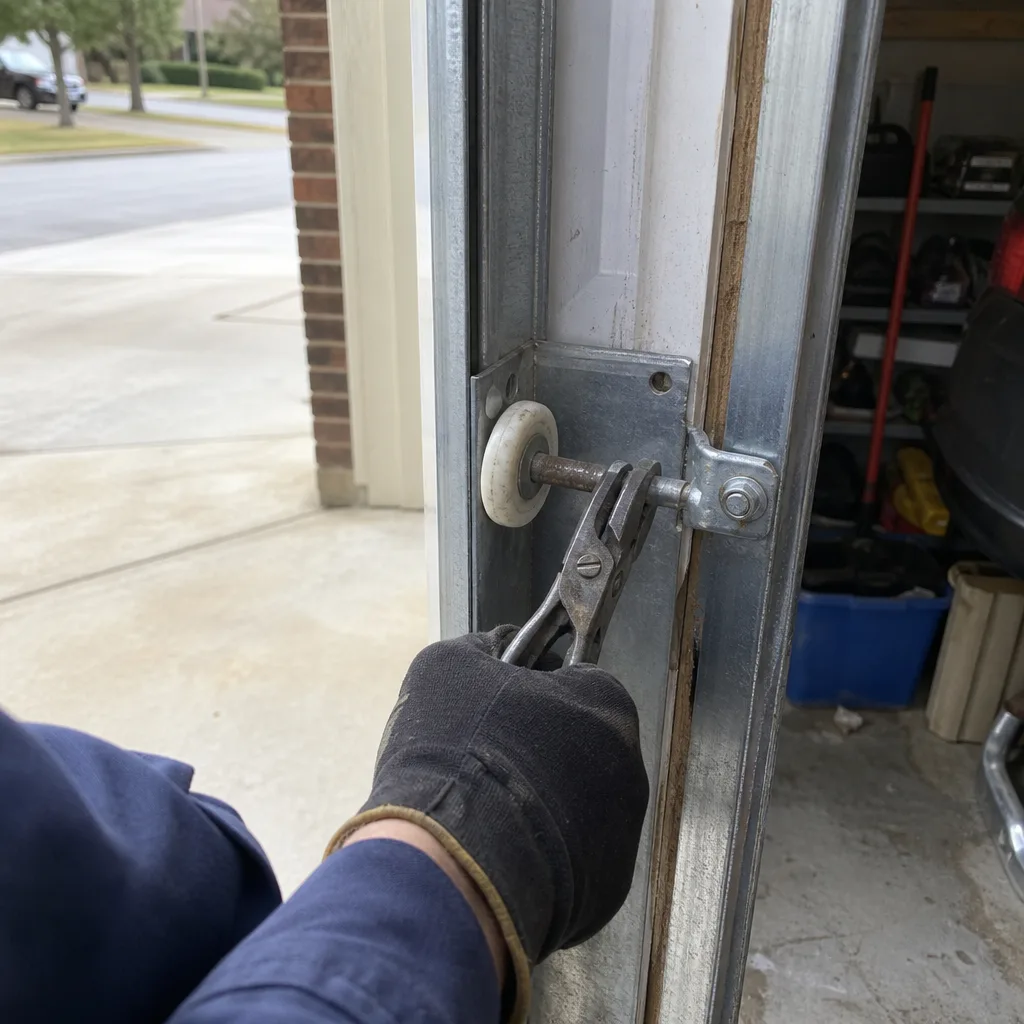
Rust on a torsion spring is the warning sign that Johns Creek homeowners are most likely to see and least likely to evaluate correctly, because Georgia humidity means almost every garage door spring shows some oxidation. The question isn’t whether there’s rust. It’s what kind.
Surface oxidation is the orange-brown film that appears on the spring coil. It’s cosmetic. The metal under the film is intact, the spring’s wire diameter is unchanged, and the spring retains its designed fatigue life. Johns Creek’s humid summers produce this film on springs that are only a few years old. It does not require replacement.
Corrosion pitting is different. Pitting is when the oxidation has eaten into the metal, creating small craters and rough patches on the coil surface. You can feel pitting with a fingernail, though you should not touch a spring under tension. You can also see it: the surface looks rough and uneven rather than smoothly coated with a rust film.
Pitting matters because of how torsion springs fail. A spring under tension is already operating near the metal’s fatigue limit. Each cycle, the steel flexes microscopically. A smooth surface distributes that stress evenly. A pit creates a stress concentration, a point where the stress is amplified. Cracks initiate at pits. The crack propagates over thousands of cycles, and one day the spring fractures at that exact point. This is why a spring with visible pitting is not “rusty but mostly fine.” It’s a spring with a known crack-initiation site.
If you see pitting, the spring should be measured and replaced before failure. The replacement cost in Johns Creek is the same $280 to $450 range, but scheduling it on your timeline is the difference between a one-hour appointment and a morning when your car is trapped in the garage.
Frayed Cables: The Time-Sensitive Warning
Garage door cables are the braided steel lines that run from the drum at each end of the torsion bar down to the bottom bracket on the door. They transfer the spring’s lifting force to the door itself. When a cable frays, it is sending a specific message: individual wire strands are breaking, and the cable’s load capacity is dropping.
This is the most time-sensitive warning sign in this guide, because cables are not redundant. If one cable snaps, the full weight of the door loads onto the other cable and the remaining hardware. If that second cable follows, and it often does within seconds, the door can drop. A falling sectional garage door is several hundred pounds of steel and wood paneling in free fall. The correct response to a frayed cable is to stop using the door immediately and call for repair.
What fraying looks like: run your eye along the cable while the door is closed. Look especially at the area near the bottom bracket and near the drum where the cable wraps. A healthy cable is smooth and uniform. A fraying cable shows small wire “hairs” sticking out from the main line, or a section where the cable looks fuzzy rather than cleanly braided.
Cable replacement in Johns Creek runs $180 to $260 for a pair, including the labor to re-tension the system. The job takes about an hour. It is quoted flat and in writing before work begins, which is the only way Servo Garage Doors Johns Creek does it. The alternative, which we’ve seen too often, is a homeowner who notices the fraying, decides to “keep an eye on it,” and then has the cable let go at 7:00 a.m. on a weekday. Emergency cable repair after a drop costs more, and the risk of damage to the door sections, track, or a car in the driveway is on the wrong side of the ledger.
Opener Warning Signs That Allow a Scheduled Appointment
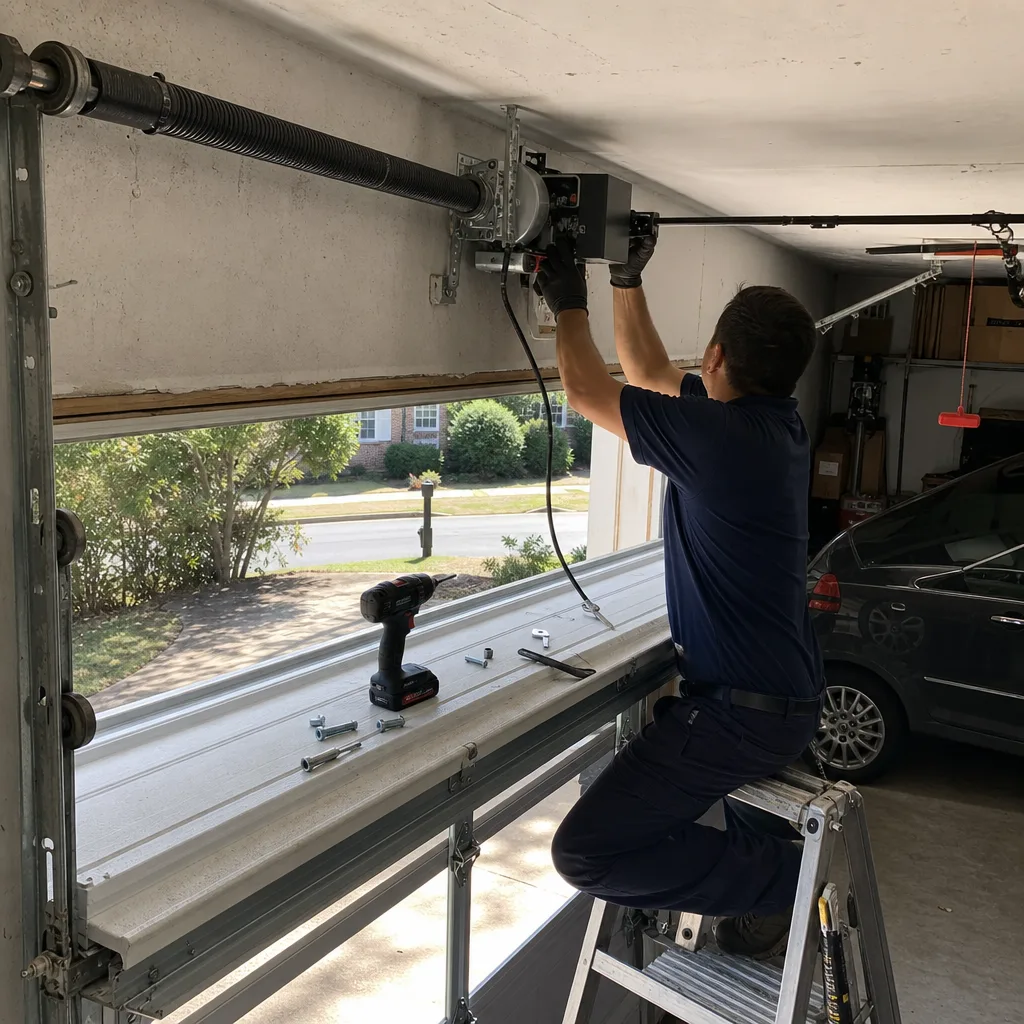
Not every warning sign is an emergency. Some conditions let you schedule at your convenience without risking a failure or injury. The key is knowing which category a symptom falls into.
An opener that takes longer than it used to is a scheduled-appointment problem. Garage door openers are designed to move the door at a constant speed. When an opener slows down, the most common causes are a worn logic board, a tired motor, or a drive belt that has stretched. None of these fail suddenly. A door that opens in 18 seconds instead of 12 seconds will keep working for weeks. The repair, which is often a new logic board at $120 to $200 or a replacement opener at $300 to $500 installed, can be planned.
An opener that reverses before the door reaches the floor is also a scheduled item, with one caveat. The reversal is usually the safety sensor doing its job: the sensor beam is interrupted by a misaligned sensor, a spider web, or a leaf in the beam path. Clean the lenses and check alignment first. If the reversal persists, the limit switch, which tells the opener where the floor is, may need adjustment or replacement. This is a $90 to $140 fix. The caveat: if the door reverses because it’s hitting an actual obstruction, like a child’s bicycle or a frozen track, that’s a different issue. But the sensor problem, by far the most common, is a scheduled appointment.
An opener that works intermittently is the gray zone. Intermittent operation points to a failing logic board or a short in the wall control wiring. It’s not dangerous in itself, but intermittent means unpredictable, and unpredictable means you might come home to an opener that won’t respond at all. We recommend scheduling this within a week.
The honest framework is this: anything involving the springs or the cables is urgent, because those components carry the door’s weight. Anything involving the opener, the sensors, or the weatherseal is schedulable, because those components do not carry weight and their failure mode is inconvenience, not a falling door.
Weatherseal and Track Wear: Johns Creek Climate Factors
Johns Creek’s climate creates two garage door wear patterns that homeowners in drier regions don’t see as often, and each has a warning sign attached.
The weatherseal is the rubber strip along the bottom of the door and the flexible seal along the sides and top of the opening. Its job is to keep rain, leaves, and insects out. Johns Creek gets about 52 inches of rain a year, and the summer humidity means that a cracked or stiff weatherseal is failing more actively than it would in, say, Phoenix. The warning sign is visible: cracks in the bottom seal, gaps at the corners where the side seal has pulled away, or daylight visible under the closed door. A failed bottom seal lets water onto the garage floor, which is how concrete pitting starts. It also creates a highway for palmetto bugs and ants. Seal replacement is a $90 to $150 job, and it’s a scheduled appointment.
Track wear is the less obvious issue. Steel tracks in a humid garage develop surface rust, and that rust creates friction. Friction makes the door work harder, which loads the springs more than they were designed for, which shortens spring life. The warning sign is a door that sounds rough even when the rollers are new or lubricated, or rust flakes visible inside the track channel. If you see it, the track may need cleaning and the rollers checked. This is a maintenance item, but it’s one that Johns Creek’s humidity makes more common than the national average.
One more note specific to this area: many Johns Creek homes have garages that are partially or fully below grade, built into the slope of the lot. These garages hold moisture longer after a rain, and moisture accelerates every rust-related problem in this guide. If your garage is below grade, expect spring oxidation, track rust, and roller wear to appear earlier than they would in a raised garage. The hardware doesn’t care that the moisture is environmental. It rusts all the same.
Common Mistakes to Avoid
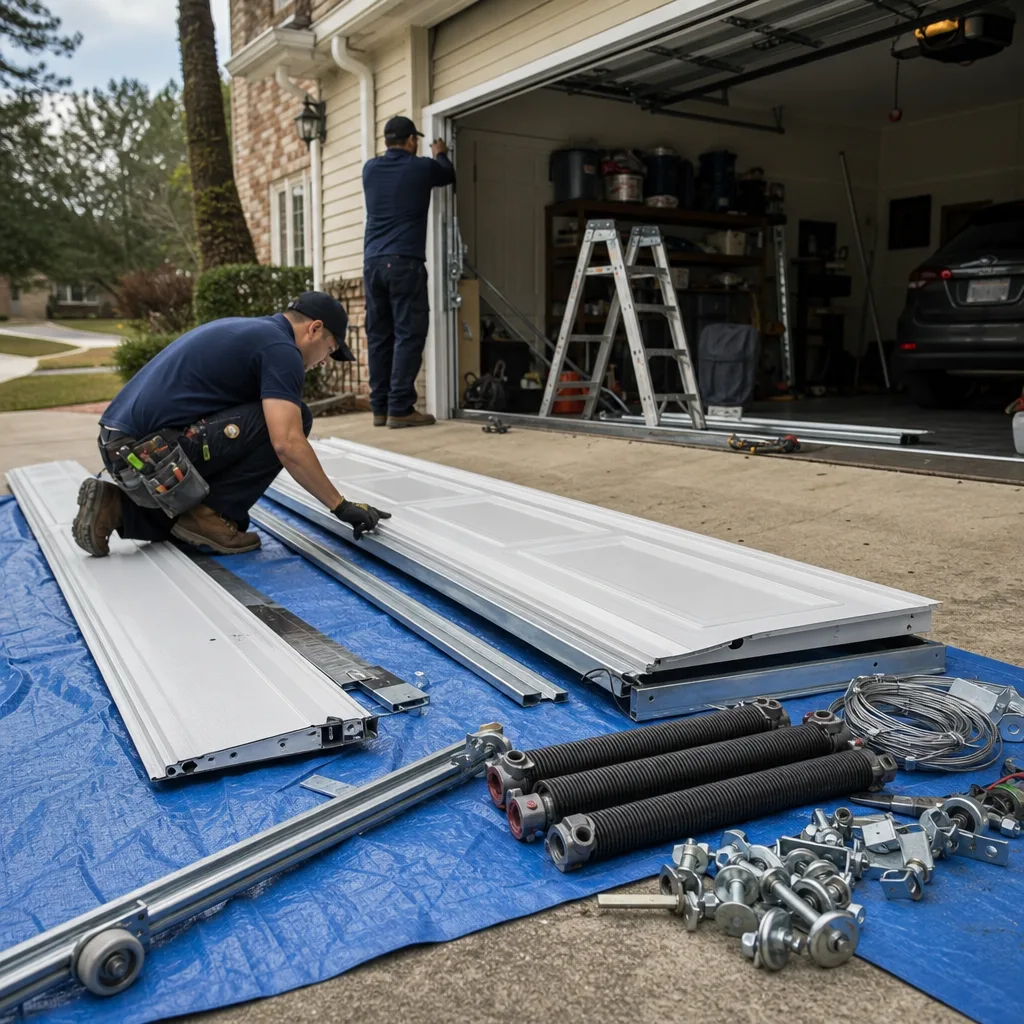
- Lubricating a grinding roller. Lubricant cannot restore a nylon roller that has worn through to its steel core. The roller is failed, and the grind will continue until the roller is replaced. The continued metal-on-metal wear scores the track, which turns a $120-$180 roller replacement into a track replacement that costs more.
- Adjusting the opener’s force setting to fix uneven travel. Uneven travel is a spring tension problem. Increasing opener force fights the imbalance with brute force, which wears out the opener’s gears and does not fix the door. The springs still need correction.
- Ignoring a frayed cable because “it’s still holding.” A frayed cable is in the process of failing. Each broken strand transfers load to the remaining strands, accelerating their failure. The time between first visible fraying and complete cable failure is unpredictable and can be days.
- Continuing to use a door after a spring pops. A garage door with a broken spring is dead weight. Operating it by hand or with the opener risks dropping the door, damaging the track, and causing serious injury. The correct action is to leave the door alone and call for emergency repair.
- Confusing surface rust with pitting corrosion. Surface rust is cosmetic. Pitting is structural. If the spring surface feels rough or shows craters, the fatigue life is compromised, and the spring should be measured and replaced on a schedule, not ignored.
- Running the door when the balance test shows heavy drop. A door that drops when lifted by hand at waist height already has a failing spring. Operating it with the opener adds cycles to a compromised spring, moving failure closer. The correct response is to schedule spring replacement.
- Dismissing a door that’s “always been a little loud.” Loudness is a symptom, not a personality trait. A door that has always been loud has always had worn rollers, dry hinges, or a rough track. Each cycle has been adding wear. The fix is usually measured, quoted, and completed the same day.
When to Call a Professional
Call immediately if the door makes a loud pop followed by loss of function, if a cable shows visible fraying, if the door drops when released from the opener, or if there’s a visible gap in a torsion spring coil. These conditions involve components under tension that carry the door’s weight, and they’re beyond any safe DIY approach. High-tension springs and cables can cause serious injury when they fail. A qualified technician has the tools and training to release that tension safely. For everything else in this guide, a scheduled appointment is the right call, and you can find more guides & resources on our blog. Servo Garage Doors Johns Creek offers free estimates in Johns Creek. Call (470) 380-0642 and a live person answers. We name a technician, text you when they’re on the way, and hand you a written price before any work begins.
Frequently Asked Questions
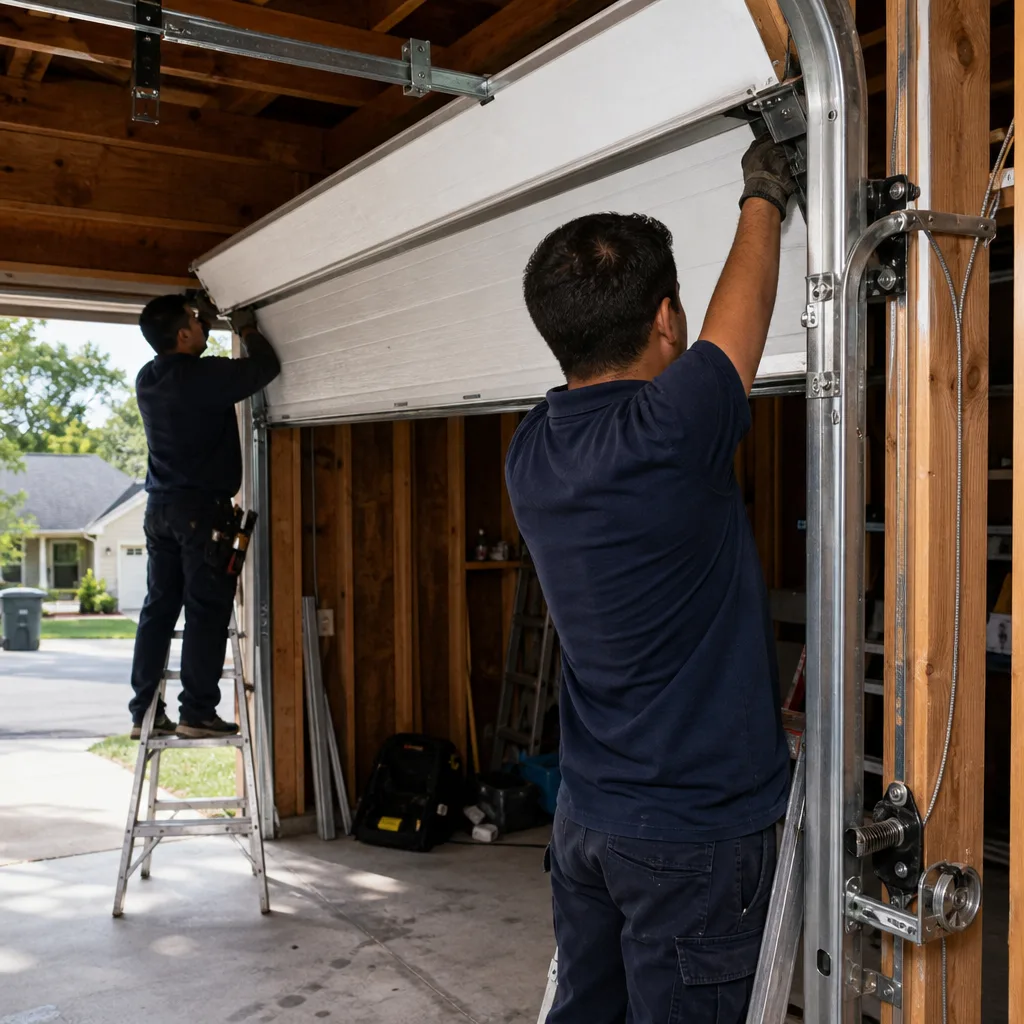
The most commonly missed warning sign in Johns Creek is a torsion spring with corrosion pitting, because almost every garage door spring in this climate shows some rust, and homeowners assume all rust is equal. Pitting is structural damage that precedes fracture. If you can see craters or roughness on the spring coil, schedule a measurement. Call (470) 380-0642 for an inspection, and the price is quoted in writing before any repair is approved.
Garage door spring replacement in Johns Creek typically ranges from $280 to $450 for a pair of torsion springs, depending on door weight and the cycle rating of the replacement springs. The price is flat and written before work starts, per Clause 1 of The Haven Standard. Servo Garage Doors Johns Creek photographs the failed spring before quoting any replacement, so you see exactly what failed and why.
Yes, a squeak that stops when you lubricate the roller bearings and hinge pins is a maintenance task. Use a garage door lubricant, not WD-40, and apply it to the roller bearings and hinge pivots. If the squeak persists after lubrication, or if it sounds like a grind rather than a squeak, the roller is worn through and needs replacement, which runs $120 to $180 for a full set in Johns Creek.
Uneven door travel is caused by a spring tension imbalance. The torsion springs supply different torque to the two cable drums, so one cable lifts faster than the other. It is not an opener problem, and changing the opener’s force setting makes it worse. The fix is a spring tension adjustment or spring replacement, quoted in writing before work begins.
Surface rust is not dangerous. Corrosion pitting is, because pits create stress concentrations where fatigue cracks initiate. A pitted spring is closer to fracture than an un-pitted spring, and a spring that fractures under tension releases stored energy suddenly. If the rust is rough or cratered, have the spring measured and replaced. Servo Garage Doors Johns Creek provides a documented photo record on every visit, so you’ll see the pitting before any work is quoted.
Spring failures, frayed cables, and a door that drops when released from the opener are emergencies, because those components carry the door’s weight and their failure can cause injury or property damage. Opener slowdowns, sensor misalignment, stiff weatherseals, and worn rollers are scheduled repairs. If you’re not sure which category you’re in, call (470) 380-0642 and describe what you’re seeing. A real person answers, 24/7.
The Bottom Line
Every garage door failure on a Johns Creek street was preceded by a signal the homeowner could have acted on sooner. The squeak that becomes a grind. The door that drifts down when lifted by hand. The rust that turns rough, the cable that grows fuzz, the spring that develops a hairline gap. None of these happen without warning. The value of this guide is that you now know what each signal means, what it costs to correct, and which ones can’t wait. When you’re ready to act, Servo Garage Doors Johns Creek gives you a flat, written price before any work starts and a photo record of what was found and what was done. Evidence, not urgency. Call (470) 380-0642.
Written by Marcus Deller, Owner at Servo Garage Doors Johns Creek, serving Johns Creek since 2015.